
Trailer Rental Near Me: Finding Practical P2P Solutions in 2026
September 14, 2026
Published by Life4Rent · Operated by Brohf Software OÜ
You finally have a free Saturday to clear out the backyard, but the local rental office closed at noon. It's a common frustration for anyone trying to secure a utility trailer rental during the hours they actually have time to work. Most corporate lots run on strict schedules that don't always align with a busy weekend project.
A reliable trailer shouldn't come with hidden mileage fees or surprise insurance surcharges that inflate your bill. You've likely felt the frustration of a final invoice that's much higher than the advertised daily rate. Local equipment is often available within your own community through peer-to-peer platforms like Life4Rent. You'll discover how to bypass the big lots and work with people in your neighborhood instead.
You'll learn how to skip the corporate paperwork and connect with owners who have the right gear ready for your specific task. Basic safety checks and license requirements are also vital to understand before you start towing in 2026. This approach keeps your costs predictable and your project on schedule.
Finding a Trailer Rental Near You Without the Corporate Hassle
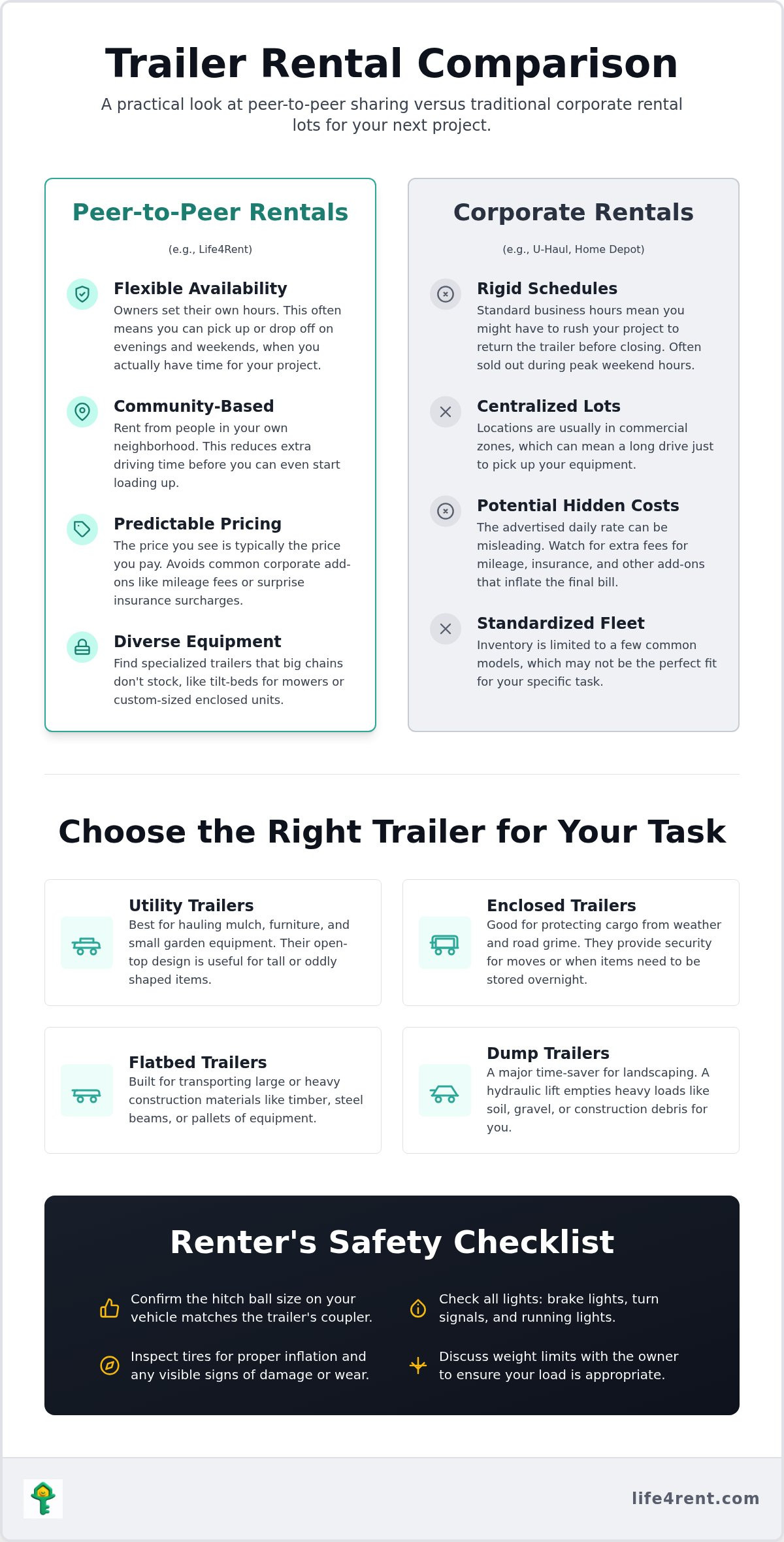
Peak moving weekends and busy landscaping seasons have a way of exposing the limits of corporate rental chains. Walk into a Home Depot or U-Haul on a Saturday morning in spring, and you'll often find the trailer lot already empty by 9am. The inventory is there during quiet midweek hours when most people are at work, which isn't particularly useful.
There's a practical alternative worth knowing about. A short clip from the Enjoy Trailer channel illustrates just how accessible trailer towing has become for everyday people, not just experienced haulers.
Why the big companies aren't always the best choice
Traditional rental offices work on schedules designed around their own operations, not yours. Most require you to return equipment before closing time, which can mean cutting a job short if you hit an unexpected delay. That rigid structure is a real problem when you're hauling garden waste or shifting furniture across town.
Corporate locations are also typically concentrated in industrial or commercial zones, not where you actually live. That means extra driving before you've even started your project. Add the queue at the counter, the paperwork, and the upsell on insurance, and a simple utility trailer rental can eat an hour of your morning before you've moved a single item.
The rise of community-based trailer sharing
Peer-to-peer equipment sharing sits within the sharing economy, a model built on the straightforward idea that privately owned assets can serve more people when they're not sitting idle. Your neighbor's flatbed trailer, parked in their driveway every weekend, is a good example of that idle capacity.
Platforms like Life4Rent connect people who own trailers with people who need them, often within the same postcode. Owners set their own hours, so pickup and drop-off times tend to be far more flexible than any rental office allows. You'll also find equipment that corporate chains simply don't stock, such as tilt-bed trailers for riding mowers or enclosed options for weather-sensitive loads.
The financial side works for both parties too. Owners earn from gear that would otherwise sit unused, and renters avoid the overhead built into corporate pricing. It's a straightforward exchange, and the local angle means you can often inspect the trailer in person before you commit.
Choosing the Right Trailer for Your Task
Select the right trailer by first looking at the weight and dimensions of your cargo. A mismatch between your load and the equipment can lead to safety issues or multiple unnecessary trips across town. Most people find that a standard utility trailer rental covers the majority of home improvement needs, but specialized tasks often require a more specific build.
Utility trailers are the standard choice for hauling mulch, furniture, or small garden equipment. These open-top models are practical because they don't restrict the height of your items. If you need to transport a tall refrigerator or a stack of plywood, an open trailer is often the most sensible option.
Enclosed trailers provide a layer of security that open models lack. They protect your cargo from rain and road grime, which is vital during a home move. These units also act as a locked storage space if you can't finish unloading your belongings in a single afternoon. If you are also using your vehicle's interior to transport smaller supplies, Carcarpit offers custom-fit liners that provide an extra layer of protection against dirt and wear.
Flatbeds and dump trailers serve more industrial purposes. Flatbeds allow you to transport large construction materials like timber or steel beams with ease. Dump trailers are a massive time-saver for landscaping projects. They use a hydraulic lift to empty heavy debris, which prevents you from having to shovel out a load of soil or gravel by hand.
Look for open-top models if your project involves tall or awkwardly shaped items. These trailers provide the vertical clearance needed for appliances or large branches. Single-axle models are usually sufficient for these household tasks because they're lighter and easier to back into a driveway.
Check for ramp gates when you browse local listings. A sturdy ramp makes it much easier to load a lawnmower, an ATV, or even a heavy trolley full of boxes. You can find these specific features by checking the available inventory from owners in your neighborhood.
Heavy-duty options for specialized needs
Specialized transport requires equipment with higher weight ratings and specific lashing points. Car haulers are a prime example; they feature low decks and heavy-duty winches for vehicle transport. These trailers ensure that a car stays centered and secure throughout the journey.
Tandem-axle trailers offer significantly better stability for very heavy loads. You'll likely need this extra support if you use an excavator rental guide to plan a major earthmoving project. Two axles distribute the weight more evenly, which reduces the chance of the trailer swaying at higher speeds.
Tilt-deck trailers are another excellent choice for heavy machinery. These models eliminate the need for separate ramps because the entire bed pivots to meet the ground. This design is safer for loading equipment with low ground clearance, as it provides a consistent, shallow angle for the climb onto the deck.
Comparing Costs: Rental Fees, Insurance, and Hidden Extras
Project budgets require a clear understanding of the total invoice, not just the daily rate. Most corporate rental lots use a low-cost entry price to attract customers, but the final bill often tells a different story. You'll find that a utility trailer rental from a large chain frequently includes mandatory add-ons that inflate the cost significantly.
Insurance is one of the most common hidden expenses. While the base rate might look like a bargain, daily insurance fees can easily double that figure. These companies often require their own coverage regardless of your existing auto policy, leaving you with little choice but to pay the premium.
Mileage charges also play a major role in the final price. If you're driving across town to reach a specific lot or making multiple trips to a disposal site, these per-kilometer costs add up fast. Life4Rent offers a different approach by allowing owners to set flat daily rates that reflect the local market without these corporate surcharges.
The true price of a corporate rental
Paperwork at a commercial lot usually contains several small fees that are easy to miss. Environmental fees and vehicle licensing recovery surcharges are standard practice for many big-box stores. These small amounts might seem minor individually, but they contribute to a much higher total than you originally planned.
Late fees are another area where corporate policies can be punitive. If you're stuck in traffic and miss the return window by thirty minutes, you might be charged for an entire extra day. Some lots also apply cleaning fees if they find dust or debris on the trailer deck, which is almost unavoidable during a landscaping project.
- Environmental fees: Often added to cover the cost of maintaining the fleet.
- Licensing recovery: A way for companies to pass their registration costs to the renter.
- Cleaning penalties: Charges for returning equipment that isn't in showroom condition.
How peer-to-peer pricing works on Life4Rent
Owners on a peer-to-peer marketplace set their own rates based on the age and condition of their equipment. This creates a competitive environment where you can find high-quality trailers at fair prices. You'll see the total cost upfront, including any service fees, before you commit to the agreement.
Direct communication with the owner also opens the door for flexibility. You can often negotiate longer-term discounts if your project is going to take a full week or more. This transparency helps you budget accurately and keeps your project on track without any financial surprises at the end of the day.
Safety and Inspection Checklist for Renters
Safety is the most important part of any haul, regardless of whether you're moving across the street or across the country. A quick inspection before you drive away with your utility trailer rental can save you hours of trouble on the roadside. You don't need to be a professional mechanic to spot the most common issues that lead to accidents.
Start with the connection between your car and the trailer. The ball size on your tow hitch must match the coupler exactly to ensure a secure fit. Common sizes include 50mm in Europe or 2-inch in other regions; a mismatch here can cause the trailer to detach when you hit a bump.
Lights and turn signals are your primary way of communicating with other drivers. Verify that the electrical plug is seated firmly in your vehicle's socket. It's a simple step that ensures everyone on the road knows when you're braking or turning.
Checking the hitch and electrical connections
Safety chains are your last line of defense if the primary hitch fails. Cross them in an X pattern under the tongue so they can catch the trailer if it ever pops off the ball. This pattern prevents the tongue from digging into the pavement, which could flip the trailer.
Test the brake lights and indicators with a partner before you leave the pickup location. If the lights don't work, check the connector pins for dirt or corrosion. A small amount of electrical contact cleaner often fixes a flickering connection in seconds.
- Safety Chains: Always cross them to create a cradle for the tongue.
- Coupler Lock: Verify that the latch is down and secured with a pin or padlock.
- Electrical Plug: Ensure the cable has enough slack to turn without pulling tight.
Verifying tire pressure and load capacity
Tires on trailers often sit for long periods, which makes them prone to dry rot even if the tread looks deep. Look for small cracks in the sidewalls and check the pressure with a gauge. You'll find the correct PSI listed on the tire's sidewall; don't just guess based on how the tire looks.
Locate the GVWR (Gross Vehicle Weight Rating) sticker on the trailer frame to know your limits. This number represents the maximum weight the trailer can safely carry, including its own weight. Axle overloads are common mistakes that lead to blown tires or broken suspension components.
Proper weight distribution is the key to a stable tow. Place about 10% of the total load weight on the tongue to prevent the trailer from swaying at high speeds. Secure every item with heavy-duty ratchet straps to keep the cargo from shifting during transport.
You can find well-maintained equipment and talk directly to owners about their utility trailer rental by checking the local trailer listings on our marketplace today.
Getting Started with Your First Life4Rent Trailer Rental
You can find a local utility trailer rental by starting with a simple search on the marketplace. Filter by category to see exactly what is available in your immediate area. This approach saves you the trip to a commercial industrial zone and keeps your business within the community.
Creating a profile and searching your neighborhood
Set your location precisely to find equipment parked in driveways just a few streets away. Real-world feedback from previous users is your best tool for finding reliable partners. Read the reviews to see how others describe the owner's communication and the trailer's condition.
Our peer to peer equipment rental guide provides more detailed advice on the logistics of these transactions. This resource explains the shift from ownership to access, which is the core of how the platform operates. It helps you understand what to expect when you move away from traditional corporate models.
Coordinating pickup and return with the owner
Message the owner directly once you find a utility trailer rental listing that looks promising. You should ask for specific dimensions of the trailer bed or confirm the weight limits relative to your car's towing capacity. Most owners are happy to provide these details to ensure a safe and successful rental for everyone involved.
Book the dates through the secure platform interface once you're satisfied with the specs. This ensures that the agreement is documented and both parties are protected. You'll then coordinate a meeting time that fits into your weekend schedule without the pressure of corporate closing times.
Take a few clear photos of the trailer from different angles at the moment of pickup. This simple habit documents the current condition and provides peace of mind for both you and the owner. Ask for a quick demonstration of any features like the ramp latch or the dumping mechanism while you're there.
Return the equipment in the same condition as you found it to maintain a high renter rating. A good reputation on the platform makes it easier to secure rentals for future projects. This cycle of trust and reliability is what keeps the community-based sharing model working for everyone.
Streamline Your Next Haul with Local Equipment
Corporate lots don't have to be your default choice when you need a utility trailer rental. You'll find better flexibility and fair rates by looking at equipment available in your own neighborhood. This approach keeps your project on track without the rigid hours of a commercial rental office.
Peer-to-peer platforms remove the stress of hidden corporate mileage fees that often inflate a final bill. You can rely on local support and real user reviews to find equipment that's well-maintained and ready to work. Secure peer-to-peer payments keep the transaction straightforward so you can focus on the job at hand.
Check the local listings before you spend your Saturday morning in a queue at a big-box store. Find a trailer for your next project on Life4Rent and get your task finished on your own schedule. Your next project will be much simpler when the right gear is just a few streets away.
Frequently Asked Questions
How much does a trailer rental near me usually cost?
Daily rates for a utility trailer rental typically depend on the size of the equipment and your specific locality. You'll usually see fair market prices that avoid the high overhead costs of national rental chains. Peer-to-peer listings allow you to compare several options within your neighborhood quickly. It's best to check the platform directly for current rates, as these are set by individual owners based on the equipment's age.
Do I need a special driver's license to tow a utility trailer?
Standard Category B licenses generally allow you to tow trailers with a weight up to 750 kg. If the Maximum Authorised Mass of your car and trailer is between 3,500 kg and 4,250 kg, you'll need a B96 entitlement. Heavier combinations require a BE license. Always check the weight ratings on the equipment and your vehicle's documentation to ensure you stay within legal limits during your project.
What happens if the trailer is damaged during my rental period?
You should report any damage to the owner immediately through the platform's messaging system. Documentation is vital, so take clear photos of the issue as soon as it happens. Most rental agreements on Life4Rent specify how repair costs are handled between the renter and the owner. A review of these terms before you start the rental helps prevent misunderstandings if an accident occurs on the road.
Can I rent out my own trailer on Life4Rent for extra cash?
Owners can list their own equipment on the marketplace to earn a percentage of each successful agreement. This is a practical way to monetize a trailer that normally sits idle in your driveway. You set your own daily rates and availability based on your schedule. It helps neighbors find local gear while you generate passive income from an asset you already own and maintain properly.
How do I know if my vehicle has the correct towing capacity?
How do I know if my vehicle has the correct towing capacity?
Your vehicle's towing capacity is found in the owner's manual or on a plate inside the driver's door. This figure dictates the maximum weight your car can safely pull. You must add the weight of the trailer to the weight of your cargo to find the total. Weight beyond this limit is dangerous and can lead to mechanical failure or loss of control on the road. If you're operating a diesel-powered rig, sourcing high-quality steering and engine components from Diesel Freak can help ensure your vehicle remains reliable under the added stress of a heavy load.
Peer-to-peer rentals typically avoid the environmental fees and licensing recovery surcharges found at big-box stores. You pay the daily rate set by the owner plus the platform service fee shown at checkout. This transparency ensures the price you see is the price you actually pay. You won't face surprise mileage charges or mandatory corporate insurance upsells that often double a standard rental bill unexpectedly.
What should I do if the trailer lights stop working?
Pull over to a safe area immediately if the trailer lights stop functioning. Check the electrical plug to ensure it hasn't disconnected from your vehicle's socket. Dirt or corrosion on the pins can often cause a bad connection, which a quick cleaning might fix. If the lights remain dark, contact the owner through the app to discuss a safe resolution or a return during daylight hours for safety.
Is insurance included in the peer-to-peer rental price?
Liability coverage from your personal auto policy often extends to a towed trailer, but it rarely covers the trailer's physical damage. You should call your insurance provider to verify exactly what is covered before you pick up a utility trailer rental. Some renters choose to add a temporary rider for extra peace of mind. Owners might also have specific insurance requirements listed in their equipment description on the platform.
Related guides on Life4Rent
Ready to rent instead of buy? See all vehicles available to rent on Life4Rent →
Life4Rent
Rent it. Earn from it. Own less, access more.
Browse peer-to-peer rentals near you, or list what you own and start earning — all protected by Life4Rent Protect.
About the author
Tallinn, Estonia
Philip leads editorial at the Life4Rent Renting Academy, overseeing guides on peer-to-peer rental, platform safety, and consumer finance across 25 markets. He has spent over a decade covering the sharing economy and digital marketplaces, helping renters and owners navigate the shift from ownership to access.