
Rent a Dunk Tank for Fundraiser: A Practical Guide for 2026
July 4, 2026
Published by Life4Rent · Operated by Brohf Software OÜ
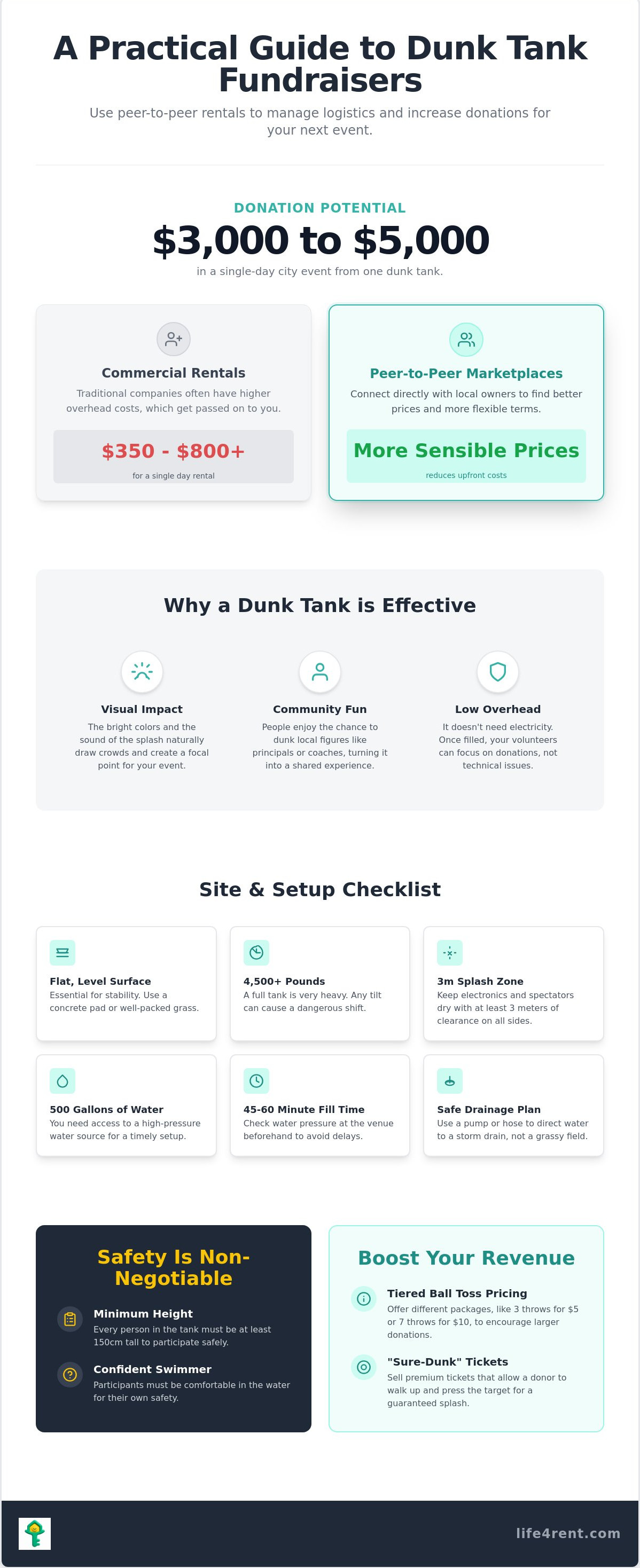
A single dunk tank can generate between $3,000 and $5,000 in donations during a one-day city event. It’s a classic crowd-pleaser, but the logistics often feel like a headache for small charity teams. You might find that commercial rental companies charge anywhere from $350 to over $800 for a single day. When you decide to rent a dunk tank for fundraiser activities, these upfront costs can quickly swallow your hard-earned revenue before the first person even gets wet.
It's frustrating to see most of your budget go toward equipment fees rather than your actual cause. You want a professional setup that doesn't compromise on safety or break the bank. This guide explains how to use peer-to-peer marketplaces like Life4Rent to find local equipment at more sensible prices. We'll cover everything from managing 500-gallon water requirements to securing event insurance so your organization stays protected.
Peer-to-peer platforms change the way we source event gear by connecting you directly with local owners. You can often find better availability during the busy summer months without the rigid terms of large commercial firms. You'll find practical advice here on pricing your throws, coordinating volunteers, and handling the setup logistics for a successful 2026 event.
Why dunk tanks are effective for local fundraisers
Dunk tanks have remained a staple of community events for decades because they offer immediate visual impact. You can see the bright colors and the target from across a crowded field. If you look at what is a Dunk Tank?, you'll see it's a proven method for grabbing attention through physical comedy and suspense. When you rent a dunk tank for fundraiser activities, you're creating a central stage for your event's biggest moments.
The tank acts as a natural magnet for spectators. People hear the splash and the roar of the crowd, which pulls them toward your donation booth. It's often the loudest part of the festival. This makes it a great spot to place your main announcement table or a secondary donation bucket for those just passing by.
To better understand how this attraction works on the ground, watch this helpful video:
The psychology of the splash
Donors don't just pay for the chance to throw a ball. They pay for a rare, fun interaction with figures of authority or local celebrities. You'll find that people are much more likely to open their wallets when the person on the seat is a well-known principal, a local coach, or a popular business owner. This dynamic turns a simple game into a community event where everyone feels involved.
The anticipation of the drop creates a shared experience that builds community engagement. Laughter and cheering are contagious in these settings. When bystanders see their neighbors having a good time, they're more likely to join the queue. This social proof is what helps some city events raise between $3,000 and $5,000 in a single day of operation.
High revenue with low equipment needs
Profit margins for these attractions stay high because the overhead is remarkably low. The tank doesn't require electricity to operate, which saves you from worrying about generator rentals or long extension cords. You only need a flat surface and a water source to get started. This simplicity makes it a reliable choice for organizers who don't want to manage complex technical setups.
A single tank can serve hundreds of participants over the course of an afternoon. Maintenance during the event is minimal. You won't have to deal with the constant supervision or the blower failures often associated with inflatable slides or bounce houses. Once the tank is full, your volunteers can focus entirely on selling tickets and managing the line.
Site requirements and equipment selection
Stability is the foundation of a safe event. You must place the tank on a flat, level surface like a concrete pad or a well-packed patch of grass. A full 500-gallon tank weighs over 4,500 pounds, so any tilt can cause the structure to buckle or shift dangerously. This isn't just about safety; it's also about ensuring the trigger mechanism works correctly every time. When you plan to rent a dunk tank for fundraiser activities, the first thing to check is your site's ground quality.
Space management is another factor that organizers often overlook. You'll need at least 3 meters of clearance on all sides of the tank to account for the splash zone. Water doesn't just stay in the tank; it sprays outward when someone hits the water. This clearance keeps your electronics, prize tables, and spectators dry.
Water and drainage considerations
Access to a high-pressure water source is the most critical logistical factor for your setup. A standard tank holds 500 gallons, and it usually takes between 45 to 60 minutes to fill with a standard garden hose. You should check the water pressure at your venue a few days before the event to avoid delays. If the hose is too far away, you'll lose valuable time during the morning setup.
A plan for drainage at the end of the day is essential. A sudden release of 500 gallons of water in one spot can quickly turn a grassy field into a mud pit or flood a nearby walkway. It's better to use a submersible pump or a long drainage hose to direct the water toward a proper storm drain. This careful planning fits into broader Fundraising Revenue Models that prioritize long-term venue relationships by leaving the site in good condition.
Standard vs folding dunk tanks
Most people choose between traditional solid tanks and newer folding models. Traditional tanks are large, one-piece units that offer the best visibility for the crowd because they often have clear windows. However, they're bulky and require a trailer or a very large van for transport. If you have limited vehicle access, these might be a struggle to move.
These folding models are much easier to transport because they break down into smaller components. You can often fit these into a standard estate car or a large SUV. You'll find that the decision to rent a dunk tank for fundraiser needs is easier when you compare these models side-by-side on local marketplaces.
Safety protocols and volunteer coordination
Safety is the most important part of any professional event. When you rent a dunk tank for fundraiser events, you have a responsibility to look after both the crowd and the person in the seat. You'll find that clear rules prevent accidents and keep the atmosphere light and fun. Every "dunkee" should be at least 150cm tall and a confident swimmer to ensure they can recover quickly after a splash.
A dedicated safety observer must stand by the tank at all times. This person shouldn't be the one handling money or selling tickets. Their only job is to watch the water and the trigger mechanism. You should also perform a quick mechanical check every hour. If the seat becomes loose or the trigger sticks, it's better to pause the game for five minutes than to risk a volunteer's safety.
Water temperature is a practical detail that many organizers forget. If the water is freezing, your volunteers will be miserable after the first dunk. You might want to fill the tank early in the morning to let the sun warm it up. A comfortable volunteer stays in the seat longer and keeps the crowd engaged.
The volunteer rotation
Short shifts are the key to a successful schedule. You should limit each volunteer's session to 20 or 30 minutes. Even on a warm day, sitting in wet clothes can get uncomfortable very quickly. You'll need to have a warm towel and a full change of dry clothes ready for them as soon as they step out of the tank.
Local celebrities always draw the biggest crowds. You'll see ticket sales spike when a well-known teacher, a local business owner, or a community leader takes their turn. It's helpful to announce these "big names" over the PA system 15 minutes before their shift starts. This gives people time to gather and get their wallets ready.
Liability and participant waivers
Legal protection is a necessary step for any public gathering. You should provide a simple waiver for every volunteer who agrees to get in the tank. This document should outline the risks and confirm that the participant meets the height and health requirements. It's a standard part of the process when you rent a dunk tank for fundraiser purposes.
The rules for throwers must be strictly enforced. You should mark a clear throwing line at least 3 to 5 meters away from the tank to prevent people from getting too close. Clear signage is also essential to keep children from climbing on the tank frame. These small steps ensure that the only person getting wet is the one who volunteered for it.
Revenue models for your event
A clear pricing strategy helps you turn a fun attraction into a serious income source for your charity. You'll find that most people prefer a simple model where they buy a set number of throws. When you rent a dunk tank for fundraiser goals, you should display these prices clearly on a large board right next to the queue. This prevents confusion and keeps the line moving during your busiest hours.
The "Sure-Dunk" option is a great way to capture donations from people who don't have a good throwing arm. They pay a higher fee to walk up and push the target button manually for a guaranteed splash. You can also sell specific time slots as "VIP" sessions when the most popular community figures are in the seat. People will often pay a premium to ensure they're present when the local principal or a well-known business owner takes their turn.
Bundling dunk tank tickets with other event offerings can boost your overall sales. You might offer a "Meal and a Splash" deal that includes a snack from the food stall and three throws at the tank. This cross-promotion encourages guests who came for the food to stick around and participate in the main attraction. It's a simple way to increase the average spend per visitor without adding much extra work for your volunteer team.
Ticket pricing strategies
A standard rate of £5 for three throws is a common choice for local events. This price point is low enough for impulse buys but high enough to build a significant total over several hours. You should set the "Sure-Dunk" price much higher, perhaps between £20 and £50, depending on the popularity of the volunteer. Bulk ticket packages, such as £12 for ten throws, often encourage families to spend more than they originally planned.
Sponsorship opportunities
Local businesses often look for ways to support community causes without managing their own booths. You can offer banner space on the tank frame or the surrounding safety fence in exchange for a sponsorship fee. These partners might also provide prizes for anyone who successfully dunks a volunteer on their first try. A "match the pot" sponsor is another effective model where a company agrees to double whatever the tank earns during a specific hour of the event.
You can browse local equipment and compare owner terms to find the right fit when you rent a dunk tank for fundraiser needs through our peer-to-peer marketplace.
The Life4Rent platform for event gear
Peer-to-peer marketplaces offer a practical alternative to commercial rental firms. You'll find that local owners often take better care of their gear than high-volume commercial warehouses. When you look to rent a dunk tank for fundraiser activities, these community-based listings can provide more flexible terms and lower costs. This shift toward peer to peer equipment rental allows non-profits to access high-quality gear without the steep overhead of traditional vendors.
You can search for equipment within your own neighborhood, which often eliminates long delivery fees. The rental process is straightforward and avoids the complexity of commercial contracts that often include hidden insurance fees or strict damage clauses. Planning becomes much simpler when you can source multiple items from the same platform. You might need a sound system to announce the next volunteer in the tank, and using Life4Rent for audio equipment rental alongside your carnival gear keeps all your logistics in one place.
Benefits of P2P for non-profits
Savings on rental fees go directly into your charity fund rather than a commercial company's profit margin. Interacting with local owners also helps build community ties that can lead to future partnerships or sponsorships. Most owners on the platform offer pickup and drop-off times that fit around volunteer schedules, unlike the rigid hours of commercial depots. This flexibility is vital when you're managing a team of people who have other commitments.
The platform's user-friendly interface allows you to communicate directly with the owner to ask specific questions about the tank's history or setup. You can verify the dimensions and water requirements before you commit to the booking. This direct line of communication builds trust and ensures that the equipment you receive matches the needs of your venue.
How to list your own equipment
Organizations can also use the marketplace to monetize their own gear between events. If your charity owns a marquee, heavy-duty tables, or even the tank itself, listing them can create a steady stream of income for your cause. A detailed listing with clear photos and honest descriptions will attract more potential renters from your local area. You keep 100% of every booking fee, which helps offset the original purchase cost of your equipment.
The protection plan on Life4Rent provides peace of mind for equipment owners. You don't have to worry about the wear and tear of frequent use because the platform includes built-in safeguards for every transaction. It's a sensible way to ensure your assets are looked after while they work to fund your next big project. You'll find that the process to rent a dunk tank for fundraiser needs is just the beginning of what the sharing economy can do for your organization.
Your plan for a successful splashdown
Successful events depend on balancing crowd entertainment with strict safety standards. You've seen how level ground and a clear splash zone prevent accidents, while smart ticket pricing ensures your cause benefits from every drop. When you plan to rent a dunk tank for fundraiser goals, remember that community engagement is your strongest asset.
Local marketplaces offer a sensible way to keep more of your budget within the charity. You can access a secure peer-to-peer marketplace with 17 categories of daily items to find everything from the tank itself to the speakers you'll need for announcements. This community-driven approach makes high-quality gear accessible for local organizers without commercial markups.
You can find an affordable dunk tank for your next event on Life4Rent and start building your schedule today. It's a reliable way to bring people together for a good cause. We hope your event is a great success.
Frequently Asked Questions
How much water does a standard dunk tank hold?
A standard dunk tank holds 500 gallons of water. This volume is necessary to ensure a safe landing for the volunteer. Once the tank is full, it weighs more than 4,500 pounds. You must make sure your chosen site is level and can support this weight without sinking or shifting during the day.
Is it safe to use a dunk tank for a school fundraiser?
It's safe to use a dunk tank for a school fundraiser as long as you follow industry best practices. You should always have an adult operator on duty to monitor the water and the trigger mechanism. Volunteers must be at least 150cm tall and able to swim. It's also a good idea to enforce weight limits, typically around 110kg, to protect the equipment and the participant.
How long does it take to fill a dunk tank with a garden hose?
It usually takes between 45 and 60 minutes to fill a 500-gallon tank with a standard garden hose. This timeframe depends on the water pressure at your venue. You should start the filling process at least two hours before your event begins to account for any delays. If the water source is far from the tank, the process will take even longer.
What is the best way to drain a dunk tank after an event?
The most effective way to empty the equipment is to use a submersible pump or a long drainage hose. You should direct the water toward a storm drain or a gravel area that can handle 500 gallons without flooding. Don't simply open the valve on a grassy field, as this will create a large mud pit. Proper drainage keeps the venue in good condition for future use.
Do I need insurance to rent a dunk tank for a public fundraiser?
You will likely need liability insurance for a public event. Most venues require a Certificate of Insurance (COI) that names them as an additional insured party. Basic event liability insurance for small gatherings often starts between $75 and $150. You should check if the owner's policy covers your specific event when you rent a dunk tank for fundraiser activities.
Can I use a dunk tank indoors if there is a drain?
You shouldn't use a standard dunk tank indoors unless the space is specifically designed for high-volume water activities. The weight of 4,500 pounds can damage many types of indoor flooring or subfloors. Even with a floor drain, the "splash zone" will likely cause water damage to walls and electrical outlets. It's much safer to keep this attraction in an outdoor setting.
What should a volunteer wear when they are in the dunk tank?
Volunteers should wear modest swimwear under a t-shirt and shorts. This combination provides comfort and maintains a professional appearance for a community event. They should never wear shoes while in the tank, as these can damage the liner or cause injury during the fall. You'll need to have a warm towel and a change of dry clothes ready for them immediately after their shift.
How far away should the thrower stand from the dunk tank?
Throwers should stand between 3 and 5 meters away from the target. This distance provides a fair challenge for the participants while keeping them a safe distance from the splash zone. You should mark this line clearly with tape or a cone to prevent people from moving closer. It also prevents accidental triggers from people bumping into the target frame.
Life4Rent
Rent it. Earn from it. Own less, access more.
Browse peer-to-peer rentals near you, or list what you own and start earning — all protected by Life4Rent Protect.
About the author
London, United Kingdom
Fred covers rental technology, app features, and platform mechanics for the Life4Rent Renting Academy. With a background in fintech journalism, he specialises in breaking down how digital rental platforms work — from payment protection and identity verification to smart pricing and booking management.