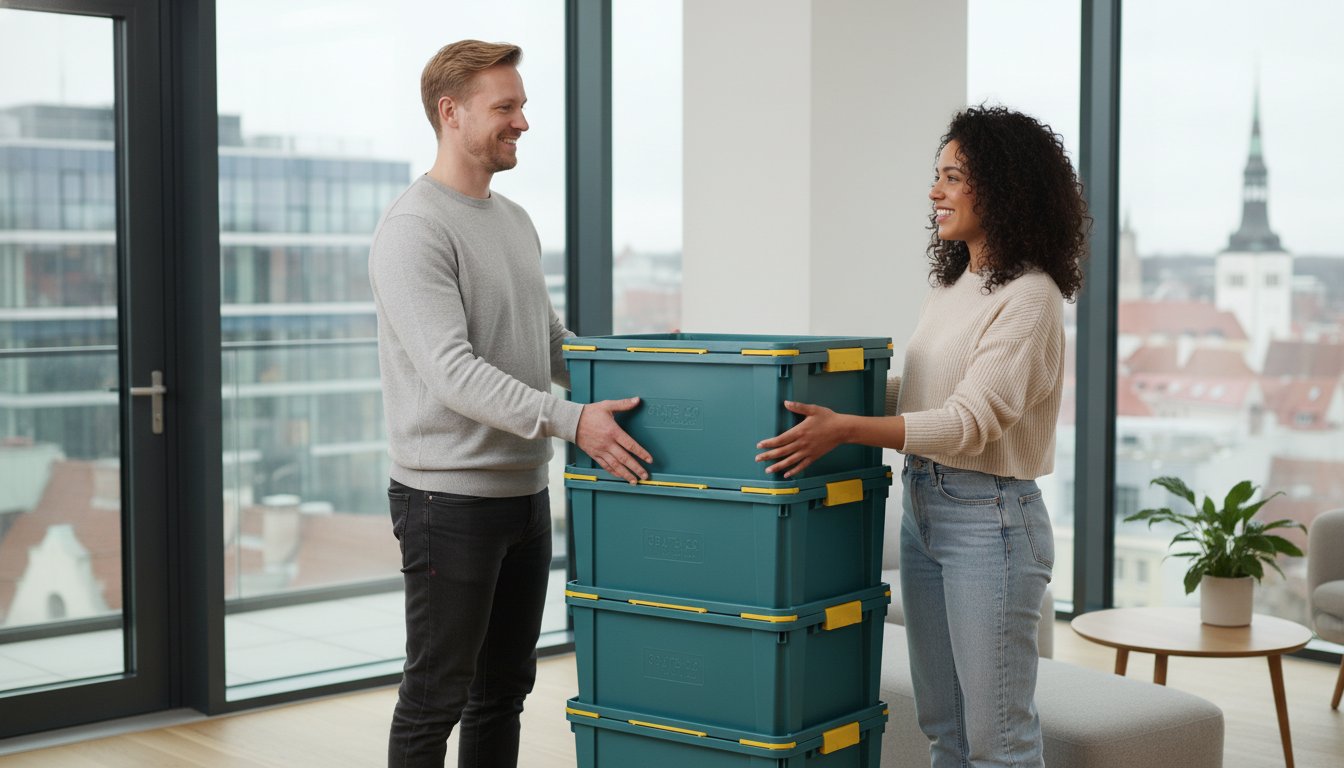
Kastj Rental Listing Template: How to Create High-Demand Crate Listings
April 5, 2026
Published by Life4Rent · Operated by Brohf Software OÜ
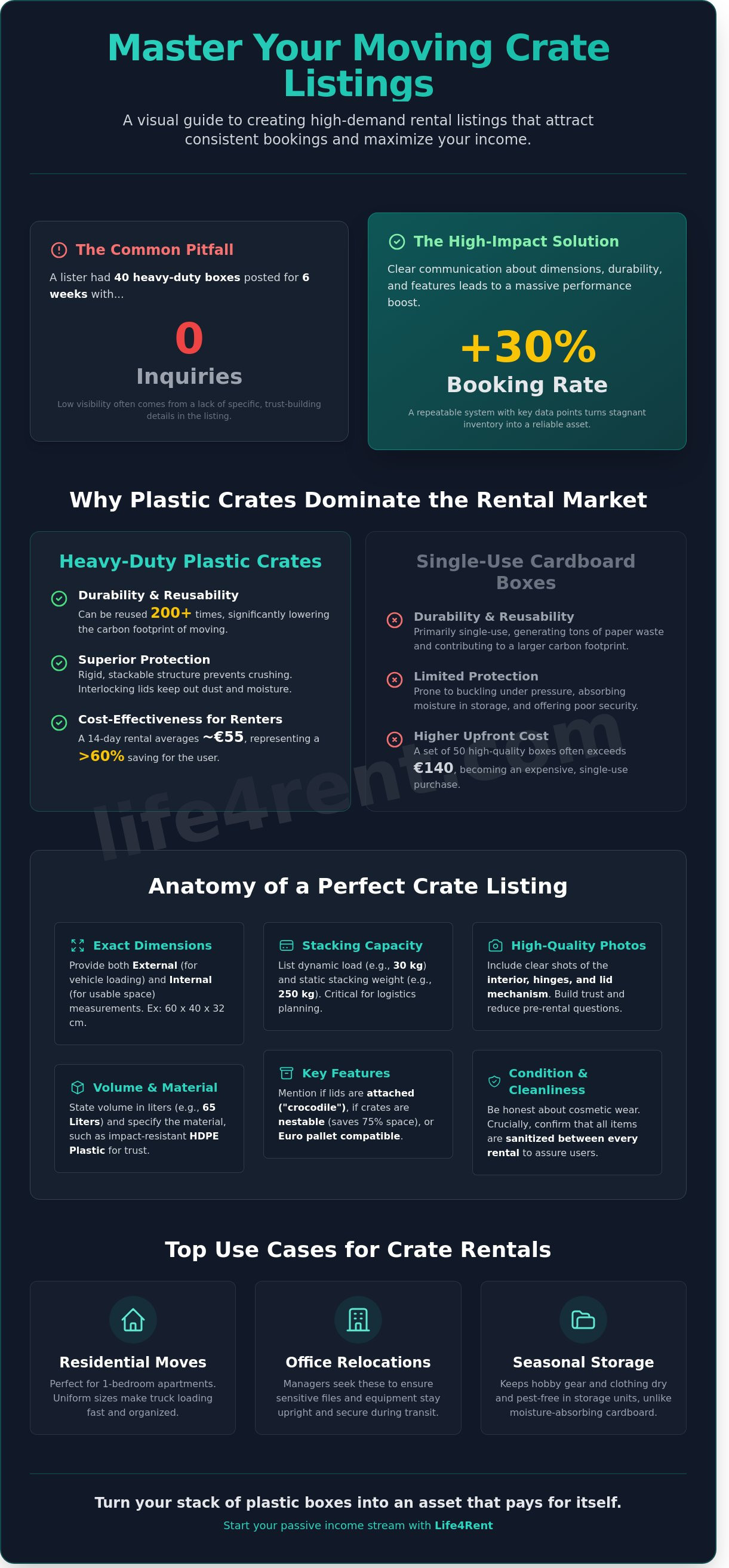
Last October, a lister named Gabor in Budapest posted forty heavy-duty moving boxes but didn't receive a single inquiry for six weeks. It's frustrating to have useful equipment taking up space while you miss out on easy cash. Most people agree that listing basic items is a simple task, yet low visibility on the kastj marketplace usually comes from a lack of specific details that build trust with a stranger.
You don't need to be a professional salesman to fix this; you just need a repeatable system that covers the basics. This guide provides a practical template for your crate and storage box listings to help you earn consistent rental income. Clear communication about dimensions and durability can increase your booking rate by 30 percent compared to vague descriptions.
We'll look at how to bundle your items for better value, set clear rules for damage, and manage the hand-off process without any headaches. These steps help you turn a stack of plastic boxes into an asset that pays for itself within four months of consistent use.
Why Kastj Rentals See High Demand in Local Markets
A kastj is a heavy-duty, stackable plastic crate built for moving and storage. These containers offer a rigid structure that protects contents better than any cardboard alternative. You can stack them safely in a van without the risk of the bottom layer buckling under pressure.
Most residents in urban centers don't have the space to store 40 empty plastic bins year-round. This logistical hurdle has fueled the growth of the sharing economy within local neighborhoods. Peer-to-peer platforms allow individuals to rent out their equipment, making these crates accessible to anyone planning a DIY move without a large upfront investment.
To better understand the practical side of listing your own equipment, watch this helpful video:
Environmental concerns drive a large portion of this demand. In cities like Chicago, municipal data from 2022 indicated that residential moves generate tons of single-use paper waste. A single heavy-duty crate can be reused over 200 times, which significantly lowers the carbon footprint of a typical relocation compared to buying new boxes.
The shift from cardboard to plastic
Plastic crates provide a level of security that paper products cannot match. They feature interlocking lids that keep out dust and moisture during transit. If you compare costs, a set of 50 high-quality cardboard boxes often exceeds €140. A 14-day rental of a professional kit typically costs around €55, which represents a saving of over 60% for the average user.
Typical use cases for your listings
Residential moves for one-bedroom apartments remain the most frequent request for these items. These renters appreciate that uniform sizes make truck loading much faster and more organized. Office managers also seek out these listings for weekend relocations to ensure sensitive files stay upright and secure during the transition.
Seasonal storage is another growing niche for kastj owners. People in cities with harsh winters use these crates to keep hobby gear or heavy clothing safe in storage units. Cardboard often absorbs moisture in these environments, but plastic keeps the contents dry and pest-free for months at a time.
The Standard Kastj Listing Template: Data Points that Matter
Renters on a peer-to-peer marketplace look for specific data before they commit to a booking. You need to provide exact dimensions for every kastj unit you list to ensure it fits the customer's needs. External measurements, such as 60 x 40 x 32 centimeters, are essential for vehicle loading plans. Internal usable space is equally important because it prevents surprises when a renter tries to pack specific equipment.
High-quality crates typically use impact-resistant polypropylene. You should state the material clearly so users know the items can handle heavy-duty transport or warehouse environments. Stacking capacity is a critical metric for logistics planning. A standard industrial crate often supports a dynamic load of 30 kg and a static stacking weight of up to 250 kg when stationary.
Clear photos help build trust and reduce the number of pre-rental questions. You should include high-resolution images that show the hinges and the interior of the crate. Photos of the lid mechanism help renters understand if the crates will fit their specific security needs or if they require additional straps. If you want to see how others format their descriptions, you can browse active crate listings to get a feel for the current market standards.
Technical specifications to include
Every listing should state the exact volume in liters for every crate size you offer. A common 600x400x320 mm crate usually holds 65 liters. You must clarify whether the lids are attached, often called crocodile lids, or if they are separate pieces. Attached lids are popular because they don't get lost during transit.
Space efficiency is a major factor for renters who have limited storage. Mention if the crates are nestable when empty. Most tapered designs allow you to save up to 75% of floor space when the units are not in use. You should also note if the crates are compatible with standard 1200x800 mm Euro pallets for larger industrial moves.
Describing the condition of your assets
Honesty about the physical state of your inventory prevents disputes later. You don't need to worry about minor scratches or cosmetic wear that doesn't affect the structural integrity. Professional renters expect some signs of use on heavy-duty plastic assets. Just ensure you mention any significant marks in the description so the renter isn't surprised upon delivery.
Users want to see a confirmation that all items are sanitized between every rental period. A quick mention of your cleaning process, such as using industrial-grade disinfectants, goes a long way. You should also highlight security features like integrated zip-tie holes. These allow for tamper-evident sealing, which is vital for customers moving sensitive documents or high-value goods.
You must follow federal and state business laws if you plan to scale your rental activity into a full-time operation. Proper documentation and transparent condition reports are part of staying compliant and professional. This level of detail ensures both parties are protected during the transaction.
Industrial Crates and Home Storage Boxes for Rent
Industrial crates typically generate more income than home storage bins because they don't break during heavy use. You can charge about €0.50 to €1.20 per day for a professional HDPE crate on the kastj marketplace. Cheap plastic bins from hardware stores rarely survive more than five trips before the lids crack or the corners shatter. High-Density Polyethylene (HDPE) is the industry standard for rental fleets for a reason. It withstands temperatures from -30°C to +60°C. This means your inventory won't get brittle if a customer leaves it in a cold garage or a hot moving van.
Uniformity helps you manage your space and your logistics. You should stick to a single footprint, usually 600x400mm. This size allows you to stack boxes safely without them sliding around during transport. While general-purpose bins are easy to find, they lack the structural integrity of specialized crates. A professional crate usually features a honeycombed base to prevent sagging. In 2023, data from European rental platforms showed that standardized industrial crates had a 40% higher utilization rate than mismatched sets of household boxes. People prefer the security of a box that was designed for heavy-duty logistics.
Choosing the right inventory
Look for crates with reinforced bases. These models often support up to 50kg, which is double the capacity of standard household boxes. You should standardize your fleet to one or two sizes to make logistics simpler for you and your renters. Check that your crates fit on 600x400mm moving dollies. If they don't, customers will find them difficult to move when they're full of books or kitchenware. A kastj listing that includes compatible dollies often sees a higher conversion rate because it solves a specific transport problem for the user.
Where to source your rental assets
Warehouse liquidations offer the best return on investment. You can often find used industrial lots for 60% less than the retail price of new plastic. Wholesale suppliers in Germany and Poland generally offer bulk discounts once you buy more than 25 units. You can also monitor local marketplaces for people selling moving kits. Many families buy 30 or 40 crates for a single move and then want them gone immediately for a low price. This is a practical way to build a fleet without a large initial shipment cost from a manufacturer.
Practical Tips for Managing Crate Deliveries and Deposits
A shipment of 50 heavy-duty crates for your kastj listing requires careful planning. You'll find that a standard hatchback like a VW Golf fits roughly 15 to 20 nested crates with the rear seats folded down. This means a full set of 50 requires three separate trips, so you must factor in fuel and time when you set your delivery price.
Your security deposit should reflect the actual replacement cost of the plastic. High-quality industrial crates usually cost between €15 and €25 each when purchased new. A deposit of €10 per crate is a fair middle ground that protects your investment without making the total upfront cost too high for the renter.
Dust and tape residue are the most common issues you'll face after a rental. You don't need to spend hours scrubbing every surface by hand. A quick spray with a garden hose or a pressure washer at a local car wash usually cleans a stack of 20 crates in under five minutes. You can include a small cleaning fee of €0.50 per crate in your kastj listing if they're returned with heavy debris.
Delivery vs. pickup options
Standardize your delivery fees based on distance to keep things simple. A flat rate of €20 for any location within a 10-kilometer radius covers your time and basic vehicle wear. You can offer free pickup if the renter has their own transport, which saves you the trouble of loading and unloading. Always meet in well-lit, public spaces like a supermarket parking lot if the exchange isn't happening at a residence for safety reasons.
Managing the rental agreement
You'll need a clear record of every transaction to avoid misunderstandings. You should use the Life4Rent protection features to ensure your rental is covered by the platform's community standards and payment security. Take a quick photo of the full stack of crates when you drop them off. This serves as a visual receipt for the total count and the condition of the plastic at the start of the term.
Late returns disrupt your schedule and might cause you to miss the next booking. You should agree on a late fee, such as €5 per day, and include this in your written terms before the rental begins. A simple paper checklist with columns for "Out" and "In" counts makes the return process fast. Both parties should sign this sheet to confirm how many items were handed back.
Create a simple grid on a piece of paper or a digital tablet for your records. Include columns for the date, the number of crates delivered, and the number returned. This small step prevents most arguments regarding missing equipment. It also shows the renter that you're a professional and organized host.
Start Your Passive Income Stream with Life4Rent
You can build a steady income by sharing your inventory on Life4Rent. Your profile represents your digital storefront, so clarity is essential. A clear photo of yourself and a brief bio about your experience with home organization builds immediate trust. People usually rent from individuals who seem reliable and organized.
Honesty is your most effective tool for building a long-term reputation. You should describe the condition of your crates accurately, including any minor scratches or signs of use. Reliable communication often matters more than the description itself. You should aim to respond to booking requests within two hours to maintain a high ranking on the platform.
You can expand your rental business once you establish a rhythm with your crates. Most movers also look for accessories to simplify their transition. You might consider adding heavy-duty dollies, moving blankets, or packing tape to your inventory. These additions allow you to provide a complete solution for anyone planning a move in your area.
Setting your first price
You can research commercial rental rates in your city to find a competitive edge. Professional firms often charge around €2.50 per crate per week. You should aim to undercut these prices by 15% to 20% to attract your first customers. If you purchased your kastj crates for €18 each, you'll likely reach your break-even point after 10 weeks of rental activity.
- Offer a 10% discount for rentals that last longer than 14 days to encourage stability.
- Calculate your total investment, including any transport costs, to track your return on capital.
- Check local classifieds to see what other individual lenders are charging for similar equipment.
Optimizing your listing for search
Search engines and internal platform filters rely on specific terminology. You must include phrases like "moving crates" and "storage boxes" to ensure your kastj listing appears in relevant searches. You should also mention your specific neighborhood or city district. This helps local renters find you without worrying about long travel distances or expensive delivery fees.
You can cross-promote your items to increase your visibility on the marketplace. You should link your crate listing to your other tool on rent offers. This shows your full inventory and encourages renters to source everything they need from a single, trusted provider. This approach reduces the logistics for the renter and increases your total earnings per booking.
Build Your Crate Rental Side Business
You can turn empty storage space into a steady income stream by following a clear structure for your listings. Most successful European hosts focus on precise measurements and clear photos to reduce back-and-forth questions. A kastj template ensures you cover the 5 key data points renters look for, such as load capacity and stackability.
Life4Rent provides a practical platform where you keep more of what you earn. They don't charge listing fees, so your initial overhead stays at zero. You'll work within a verified user community where secure payment handling is standard for every transaction. This setup helps you manage deposits without the common stress of private bank transfers.
You can start with just five or ten crates to test the local demand in your area. It's a low-risk way to see how peer-to-peer rentals work for industrial or home storage gear. List your first set of crates on Life4Rent today. You'll find that clear communication and honest descriptions lead to the most reliable rental blocks.
Frequently Asked Questions
What exactly is a kastj in the context of rentals?
A kastj is a heavy-duty, stackable plastic crate designed for moving and storage. These items serve as a durable alternative to cardboard boxes because they don't collapse or tear. Most users on the platform list them to help people transport fragile items safely across the city without generating waste.
How much can I realistically earn by renting out moving crates?
You can realistically earn between €2 and €4 per crate for a seven-day rental period. A host with 50 units can generate €300 in a single two-week booking. Many owners in European cities find their equipment pays for itself within 10 rental cycles if they maintain high occupancy rates.
Do I need to provide insurance for the items inside the crates?
You aren't responsible for insuring the items placed inside the crates. Renters usually rely on their own moving or home insurance policies for their personal belongings during a transition. Your job is to ensure the crates are in good condition when the rental starts and to document any pre-existing wear.
What is the best way to clean plastic crates between rentals?
Use a simple disinfectant spray and a clean cloth to sanitize each kastj after it's returned. A garden hose or low-pressure washer is effective for removing dust from the exterior ribs if the crates were used in a garage. You must let them air dry completely before you stack them for the next user to prevent odors.
What happens if a renter loses or breaks one of the crates?
You should charge the renter the full replacement cost if a crate is lost or cracked during their booking. Most professional-grade crates cost about €20 each to buy new from industrial suppliers. You'll want to list these costs clearly in your description so the renter knows the financial stakes before they agree to the terms.
How many crates should I include in a standard moving kit?
A set of 30 crates is the standard starting point for a small one-bedroom apartment move. Families moving from a three-bedroom house typically need 75 to 100 units to pack everything securely. You can provide better value by matching your kit sizes to these common housing types rather than offering random quantities.
Is it better to offer individual crates or fixed bundles?
Bundles are more practical than individual listings for both the host and the renter. Most moves require at least 20 units, so managing dozens of single-item rentals is a logistical headache. You can offer a base package for a flat fee and then allow add-ons in increments of five for larger projects.
How do I handle the security deposit for a large number of items?
You should set a security deposit that covers roughly 50% of the total kit replacement value. For a 40-crate set worth €800, a deposit of €400 is reasonable to protect your investment. The platform handles the transaction, which protects you from having to ask for cash on the doorstep during the hand-off.
Life4Rent
Rent it. Earn from it. Own less, access more.
Browse peer-to-peer rentals near you, or list what you own and start earning — all protected by Life4Rent Protect.
About the author
Stockholm, Sweden
Stella researches and writes about sustainable consumption and the circular economy for the Life4Rent Renting Academy. She previously worked at a Nordic sustainability research institute studying how access-over-ownership models reduce household CO₂ emissions, and translates that research into practical guides for everyday renters.