Boom Lift Rentals Near Me: A Practical Guide to Local Options in 2026
Michael Wright
July 24, 2026
The obvious choice for renting a boom lift is usually a big corporate yard like United Rentals or Home Depot. But that obvious choice often comes with a surprise delivery invoice, a rigid 8-to-5 pickup window, and a staff member rattling off platform heights and outreach specs like you've done this a hundred times before.
If you've ever searched "rent tools from neighbors near me" out of frustration with exactly that experience, you're not alone. Most people just want something that reaches the roofline, sits within a reasonable drive, and doesn't require decoding a 12-page rental agreement to figure out what you're actually paying.
This guide cuts through the noise. You'll learn how to locate a boom lift within your area, understand which type actually fits your job without the jargon, and see how peer-to-peer platforms like Life4Rent compare to traditional rental yards on price, flexibility, and convenience. There are real trade-offs on both sides, and by the end you'll know which route makes sense for your specific situation.
How to choose a boom lift for your specific task
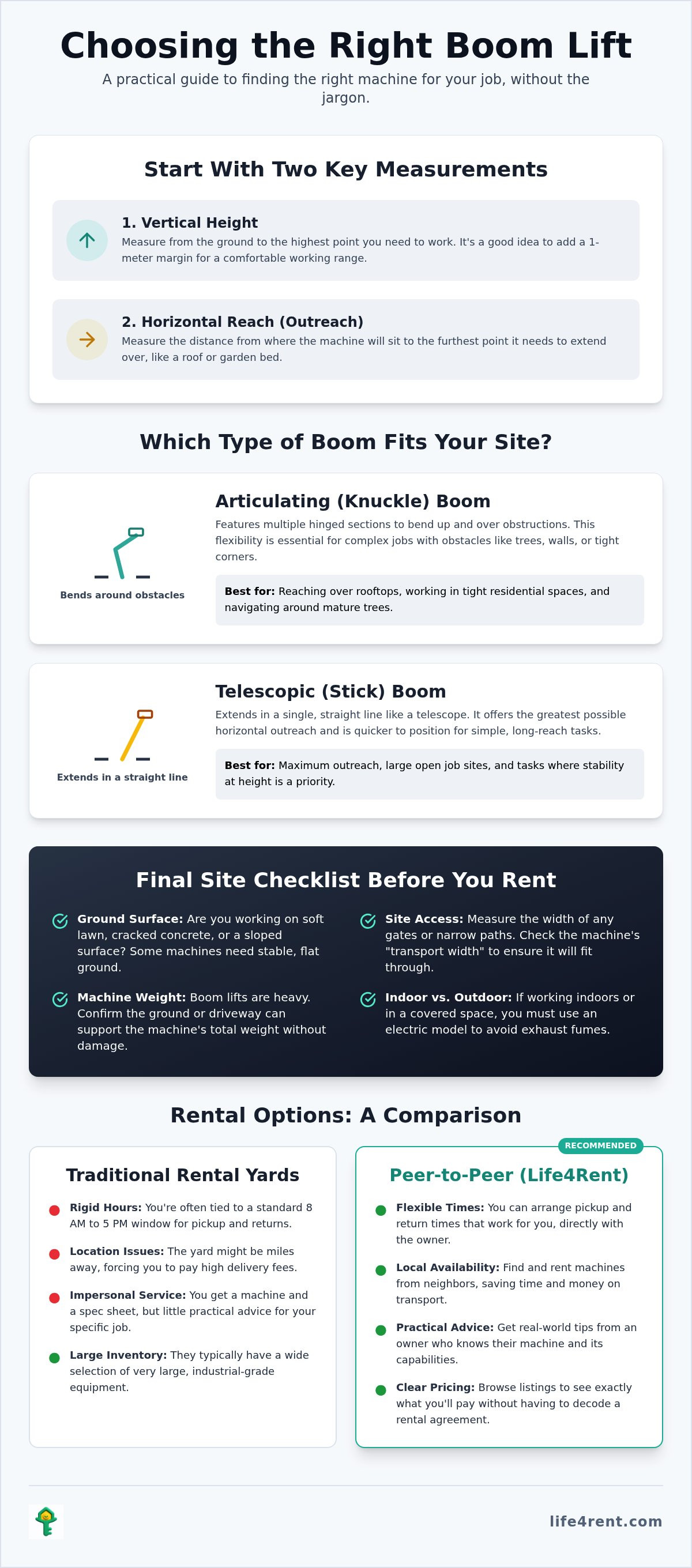
A boom lift is, at its core, an aerial work platform mounted on an extendable arm, and the arm configuration matters far more than most first-time renters expect. Before you start comparing prices or availability, you need two numbers: how high you need the platform to go, and how far out it needs to reach. Get those wrong and the machine simply won't do the job, regardless of what it costs you per day.
Most residential jobs, like repainting a two-storey facade or clearing gutters, don't need anything close to the industrial-scale machines that corporate yards push. That's where searching to rent tools from neighbors near me can actually work in your favour. Local owners tend to have smaller, more practical machines, and they'll often tell you straight whether their lift is the right fit for your site rather than just handing you the keys.
Assess your vertical and horizontal reach
Vertical height is the straightforward one: measure from the ground to the highest point you need to work at, then add a metre or so of comfortable working margin. Horizontal reach is where people get caught out. If you need to lean the arm over a pitched roof or extend across a garden bed without repositioning the machine, you need to know the maximum outreach the boom provides at the height you're working at. These two figures aren't independent; most booms trade one for the other as the arm extends.
A tape measure and a rough sketch of your site will save you more trouble than any spec sheet. Measure the distance from where the machine will sit to the furthest point you need to reach, not just the wall height.
Check the ground surface and site access
This is the detail that corporate rental listings almost never address. Boom lifts are heavy, and soft ground, cracked concrete, or a freshly laid lawn can be a problem before the arm even goes up. Check whether you need rough-terrain tyres for uneven surfaces or non-marking wheels for a tiled driveway or indoor space.
Gate width is another thing worth measuring before you commit to a booking. Many residential properties have side gates between 90 cm and 110 cm wide, and a compact boom that looks small in photos can still be too wide to pass through. Ask the owner for the machine's transport width, not just the platform size.
- Soft lawns: look for machines with outrigger pads or low ground pressure ratings
- Narrow access: confirm transport width fits your gate before booking
- Cracked driveways: check whether the machine's weight is within what the surface can handle
- Indoor or covered work: electric models produce no exhaust and are the only practical option
When you rent tools from neighbors near me through a platform like Life4Rent, you can message the owner directly with these questions before you confirm anything. That kind of practical back-and-forth is hard to replicate at a corporate counter.
Telescopic versus articulating boom lifts
Once you've confirmed your height and outreach numbers, the next decision is mechanical: how does the arm actually get there? There are two fundamentally different designs, and they're not interchangeable. Picking the wrong one won't just slow you down; it can make the machine useless for your specific site.
A telescopic boom extends in a straight line, like pulling sections out of a fishing rod. An articulating boom has multiple hinged sections that bend at joints, letting the arm curve around objects rather than push past them. Both reach height. They do it in completely different ways.
Articulating lifts for complex angles
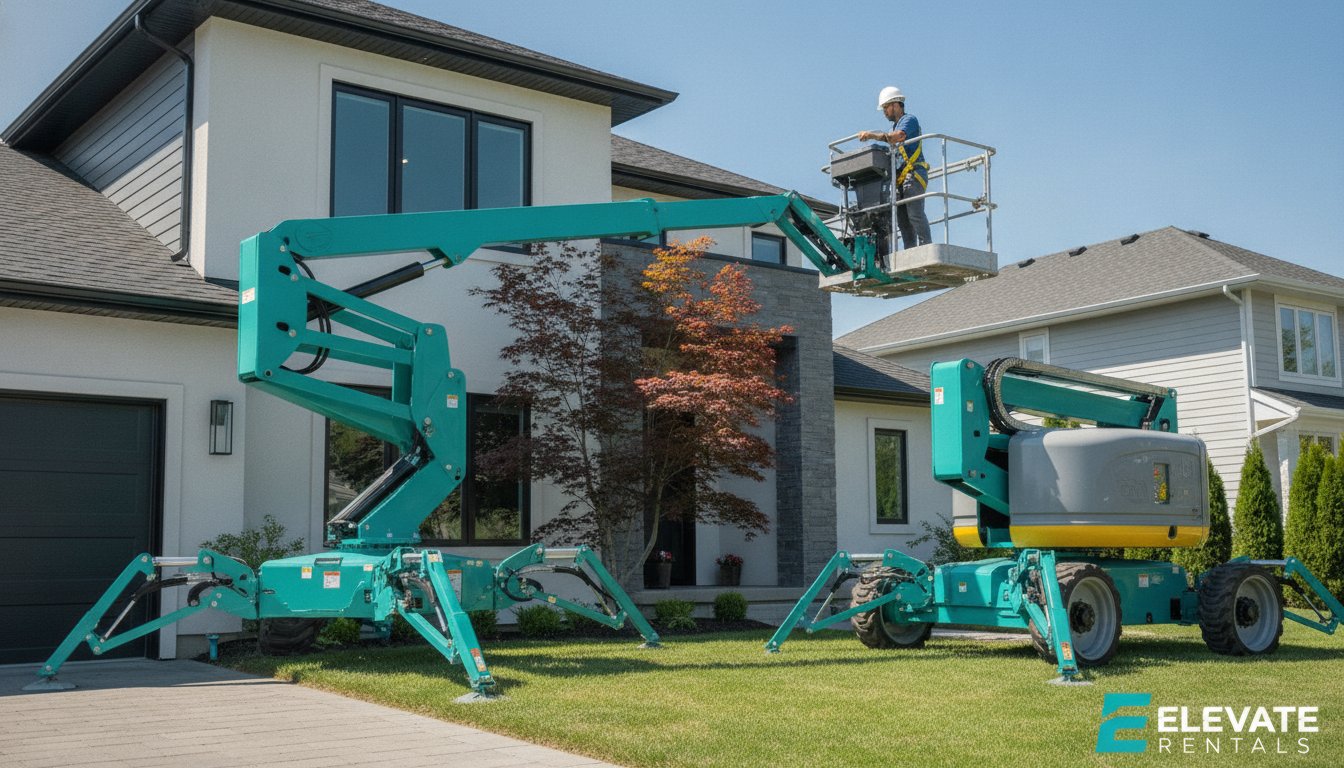
These are sometimes called knuckle booms, which is a decent description of how the joints work. The arm can fold up, over, and then down again, which means you can position the platform above a garage roof or around a mature tree without moving the machine's base. In tight residential spaces, that flexibility is genuinely useful. If you're working in a garden with a tree line close to the house, an articulating boom is almost always the right call. When you rent tools from neighbors near me through a platform like Life4Rent, local owners of articulating models often know exactly which residential scenarios their machine handles well, so it's worth asking.
Telescopic lifts for maximum outreach
Telescopic booms extend quickly and hold their position with less flex at height, which makes them the more stable option when you're working at the upper end of a machine's range. They're well suited to large, open jobs: painting a warehouse exterior, cleaning a flat commercial facade, or maintaining a structure with no obstacles between the machine and the work surface.
The trade-off is manoeuvrability. Telescopic booms need more clear space around the base to operate safely, and they can't bend around anything in their path. On a residential property with mature planting or tight boundaries, that limitation matters.
Here's a quick summary of where each type performs best:
- Articulating boom: working over or around obstacles, tight residential gardens, multi-angle access points
- Telescopic boom: large open sites, maximum horizontal outreach, stable work at significant height
- Either type: flat, clear surfaces where the platform just needs to go straight up
If you're not sure which applies to your job, sketch the site from the side and mark where the machine will sit relative to the obstacle or structure. That drawing will tell you more than any spec sheet.
Comparison: Traditional rental yards versus peer-to-peer markets
Corporate rental yards have one model, and it works well for them: you pick up, you return within 24 hours, and anything outside that window costs extra. That rigidity makes sense when you're managing a fleet of hundreds of machines across multiple locations. It makes less sense when your job runs long on a Tuesday and you need the lift until Wednesday afternoon.
Peer-to-peer platforms like Life4Rent work differently because the people listing equipment aren't running a logistics operation. They're owners with a machine sitting idle, and they're generally happy to work around your schedule rather than the other way around. That flexibility alone solves a problem that catches a lot of renters off guard.
There's also the availability gap. Corporate yards get cleaned out during busy seasons, particularly in spring and early summer when everyone's doing exterior work at the same time. When the big yards are sold out, the search to rent tools from neighbors near me stops being a budget decision and becomes the only practical option. Local owners don't face the same demand spikes, and a machine that's been sitting in someone's garage all winter is just as functional as one from a corporate fleet.
Price transparency and hidden fees
The headline rate at a corporate yard rarely reflects what you actually pay. Environmental disposal fees, mandatory damage waivers, and fuel surcharges get added at the counter, often without much explanation. On a marketplace listing, the price you see is the price you discuss with the owner directly. There's no checkout screen adding line items you didn't agree to. If you need the machine for a week rather than a day, it's also much easier to negotiate a reduced rate with an individual owner than to work through a corporate discount structure.
Personal communication with equipment owners
This is where peer-to-peer genuinely pulls ahead. An owner who's used their boom lift on a dozen residential jobs will tell you things no rental yard staff member would think to mention: which direction the controls feel stiff in cold weather, whether the outriggers need a rubber mat on gravel, or how much clearance the arm needs when folding down. That kind of practical knowledge doesn't appear in any spec sheet.
It's not just about tips, either. If something unexpected comes up mid-job, you're messaging a real person who has a stake in the machine being used properly, not waiting on a corporate helpdesk that routes you through three departments before anyone picks up.
- Flexible return windows: individual owners can often accommodate schedule changes that corporate yards won't
- No surprise fees: marketplace listings show agreed costs without checkout-stage additions
- Honest availability: peer listings exist independently of corporate stock shortages
- Direct support: questions go to the person who owns and operates the machine, not a call centre
None of this means corporate yards are always the wrong choice. If you need delivery, a formal damage waiver, or a machine that's been serviced to a documented standard, a corporate yard provides that structure. But for most residential jobs where you can collect locally, the peer-to-peer route through a platform like Life4Rent is simply a more straightforward transaction.
Safety and logistics for heavy equipment rentals
A boom lift is not a ladder. That sounds obvious, but the gap between knowing it and acting on it is where most accidents happen. Before you leave the ground, there are a handful of non-negotiable checks that apply whether you rented from a corporate yard or found the machine through a search to rent tools from neighbors near me. The machine's origin doesn't change the physics.
Start with a walk-around before you touch the controls. Check the hydraulic lines for any visible weeping or cracking, confirm the outriggers deploy and lock properly, and test the emergency lowering function from ground level before anyone climbs in. Corporate yards won't hand you this checklist. It's worth having it written down before you arrive to collect.
One check that's easy to forget until you're already in the basket: overhead power lines. Identify every line within the machine's maximum reach radius before you raise the platform. The safe approach distance from energised lines varies by voltage, so if you're not certain, treat any overhead line as live and keep the arm well clear of it.
Fall arrest systems and what to check
A full-body harness attached to the basket's designated anchor point is not optional. It's not a suggestion on the safety card. If the machine tips or the platform moves unexpectedly, the harness is the only thing keeping you on the right side of a serious injury. Before climbing in, inspect the harness webbing for fraying, check that the buckles click and hold, and confirm the lanyard attachment point inside the basket is rated for the load. A worn or incorrectly fitted harness is functionally useless.
- Inspect the webbing: look for cuts, abrasion, or discolouration that suggests chemical exposure
- Check the buckles: each one should click firmly and resist a sharp tug
- Attach to the anchor point: the basket's designated ring, not the railing
- Confirm lanyard length: it should limit a fall to well within the basket depth
Trailer requirements and towing logistics
If delivery isn't included in your booking, you'll need to move the machine yourself. Many smaller boom lifts are towable, which is convenient, but only if your vehicle is actually rated for the weight. Check your truck or SUV's towing capacity against the machine's gross weight before you confirm anything. Getting this wrong isn't just a mechanical problem; it's a road safety issue.
Ask the owner whether the rental includes a trailer or whether the lift is self-propelled and needs to be driven onto a flatbed. Some towable models require specific hitch ratings or brake controller compatibility, so confirm those details during your initial message rather than in the car park when you're trying to leave.
Ready to find a boom lift near you with an owner who can talk you through the logistics before you commit? Browse local equipment listings on Life4Rent and message the owner directly with your site details.
Use Life4Rent to find local machinery
Life4Rent is built around a straightforward idea: the person three streets over probably owns something you need, and they'd rather it earned them something than sat unused in a garage. The platform covers 17 rental categories, from tools and outdoor equipment to electronics and baby gear, which means you're not limited to one type of search when a job requires more than one piece of kit.
For anyone trying to rent tools from neighbors near me without the friction of a corporate yard, the location-based browsing is the practical starting point. You're not scrolling through a national inventory hoping something nearby happens to be available. You filter by your area, see what's actually within a few miles, and go from there.
Search local listings for the best deals
The filter works at neighbourhood level, so you can narrow results down to a realistic collection radius before you even look at pricing. Once you've got a shortlist, check the owner's ratings and any reviews left by previous renters. A listing with several completed rentals and honest feedback tells you considerably more than a polished product photo.
If you don't have a trailer, message the owner before committing. Some owners are willing to arrange drop-off, particularly for heavier equipment like boom lifts, and it's much easier to sort that out in a direct conversation than to discover it's not an option after you've confirmed the booking. The platform's messaging keeps everything in one place, so there's a clear record of what was agreed.
The range of available equipment is broader than most people expect. Alongside boom lifts, you'll find listings for excavators and other heavy machinery, which makes Life4Rent a practical first stop for any project that involves more than one type of equipment.
Protection for owners and renters
The marketplace structure means both sides of the transaction have a record of what was agreed, what condition the equipment was in at handover, and what the rental terms covered. That's not a small thing when you're dealing with machinery that costs several thousand pounds to replace.
- Renters can review the owner's history and confirm equipment condition before committing
- Owners have a documented record of the rental agreement and can build a reputation through reviews
- Both parties communicate through the platform, keeping the conversation traceable if anything needs resolving
For owners, there's a straightforward case for listing underused machinery. A boom lift sitting idle between jobs generates nothing. Listed on Life4Rent, it can cover its own storage costs and then some, without requiring you to run a rental business or manage a fleet. You set the terms, agree the dates, and the platform handles the payment side securely.
That community-based structure is also what makes high-end equipment accessible to people who'd never justify a corporate rental rate for a single weekend job. The tool exists. The person who needs it is nearby. Life4Rent is just the connection between them.
The Right Lift Is Closer Than You Think
The main thread running through this guide is straightforward: the right boom lift for most residential jobs isn't the biggest machine at the nearest corporate yard. It's the one that fits your site, suits your schedule, and comes from someone who can actually talk you through the details before you commit.
Getting your height and outreach numbers right, choosing between telescopic and articulating based on your specific obstacles, and running a proper pre-operation check will take you further than any amount of comparison shopping. Those fundamentals don't change regardless of where you rent from.
What does change is the experience. When you want to rent tools from neighbors near me without the rigid return windows and checkout-stage fees, a peer-to-peer marketplace is simply a more practical fit for the way most residential jobs actually run.
Thousands of users are already finding the equipment they need closer to home, often at a better rate than corporate yards offer. Browse boom lift listings on Life4Rent and message a local owner today. Your project doesn't need to wait for a corporate fleet to free up.
Frequently Asked Questions
Do I need a special licence to rent a boom lift for my home project?
In most countries, you don't need a formal licence to operate a boom lift on private residential property, but the legal picture varies significantly by location. Some regions require IPAF certification or an equivalent operator card for any aerial work platform, regardless of whether the job is commercial or domestic. Before you rent tools from neighbors near me or anywhere else, check your local authority's requirements, because getting this wrong isn't just a paperwork issue.
If you're unsure, the owner you're renting from is often a useful first call. Many have operated their machine on residential jobs and know what's typically expected in your area, though they can't give you legal advice. For anything involving a public road or commercial premises, check with your local health and safety body directly.
How much does it usually cost to rent a boom lift for a single day?
Daily rates vary considerably depending on the machine's size, type, and where you're renting from, so quoting a specific figure here would be misleading. What's consistent is that peer-to-peer listings tend to reflect negotiated rates between two people rather than a fixed corporate price card, which means there's often more room to discuss the cost if your job runs across two days or you're collecting rather than requesting delivery.
The honest advice is to get two or three quotes before committing. Check what's included in each one, because a lower headline rate with a mandatory damage waiver and fuel surcharge can end up costing more than a slightly higher flat rate from a local owner with no add-ons.
Can I use an articulating boom lift on an uneven or sloped driveway?
Most boom lifts have a maximum allowable gradient, typically between two and five degrees depending on the model, and operating outside that range is a genuine safety risk rather than a minor inconvenience. Articulating models are no different in this respect. If your driveway slopes noticeably, ask the owner for the machine's rated working gradient before you book, and measure your slope if you can.
On mildly uneven surfaces, outrigger pads can help distribute the load and level the base, but they don't compensate for a slope that exceeds the machine's rated tolerance. If the ground isn't flat enough, the safest option is repositioning the machine rather than adjusting your working method around an unstable base.
What happens if the boom lift breaks down while I'm using it?
Your first priority is getting the platform back to ground level safely. Every boom lift has a manual or emergency lowering function, usually accessible from ground level, and you should locate and test this before anyone climbs in. It's one of the pre-operation checks worth doing regardless of where you rented the machine.
Once you're safely down, contact the owner immediately and document what happened with photos if possible. On a peer-to-peer platform like Life4Rent, the messaging thread creates a clear record of the timeline. Whether the rental continues, ends early, or results in a partial refund is a conversation between you and the owner, so having that record matters. Mechanical failures do happen, and most owners would rather know quickly than discover the problem after the fact.
Is insurance included when I rent equipment from a neighbor on Life4Rent?
Life4Rent provides a platform for connecting owners and renters, but the insurance position for any specific rental depends on the individual listing and the terms agreed between both parties. Don't assume coverage exists without confirming it. Ask the owner directly what's in place, and check whether your own home or contents insurance extends to rented equipment, as some policies do cover this.
For high-value machinery like a boom lift, it's worth spending a few minutes on this before you collect. Some owners carry their own equipment insurance that covers third-party use; others don't. A short conversation during the booking process is far less stressful than a dispute after something goes wrong.
How do I transport a 40-foot boom lift to my construction site?
A machine with 40-foot reach is typically too large to tow on a standard trailer behind a passenger vehicle. You'll almost certainly need a flatbed truck or a low-loader with a ramp, and the vehicle doing the towing needs to be rated for the machine's gross weight. Check both the towing capacity and the trailer's rated load before you commit to a transport plan.
The practical alternative is to ask the owner whether delivery is an option. For larger machines, many owners have their own trailer setup or can recommend a local haulier they've used before. Sorting transport logistics during your initial message rather than the morning of collection will save you a significant amount of stress, particularly if the site has restricted access or a tight delivery window.
Can I rent a boom lift if I live in a city like Tallinn or London?
Yes, though availability in dense urban areas depends on what local owners have listed at any given time. Cities actually have a reasonable pool of peer-to-peer equipment listings because more people own machinery and more people need it. The practical challenge in urban areas tends to be logistics rather than availability: narrow streets, parking restrictions, and permit requirements for operating heavy equipment on or near public roads.
If you want to rent tools from neighbors near me in a city, filter by your specific neighbourhood on Life4Rent rather than searching the whole city. You're more likely to find something within a practical collection radius, and a local owner will have a much better sense of which access routes and operating conditions actually work in your area than a corporate yard on the outskirts would.
Related guides on Life4Rent
Ready to rent instead of buy? See all tools & equipment available to rent on Life4Rent →
Life4Rent
Rent it. Earn from it. Own less, access more.
Browse peer-to-peer rentals near you, or list what you own and start earning — all protected by Life4Rent Protect.
About the author
Michael Wright
Dublin, Ireland
Michael covers consumer rights, rental law, and EU platform regulation for the Life4Rent Renting Academy. He has reported on digital market policy and renter protections across Europe, and brings a clear, practical perspective to topics like deposit disputes, insurance, and the legal rights of renters and owners.