Make money from your stuff: A practical guide to the rental economy in 2026
March 20, 2026
Published by Life4Rent · Operated by Brohf Software OÜ
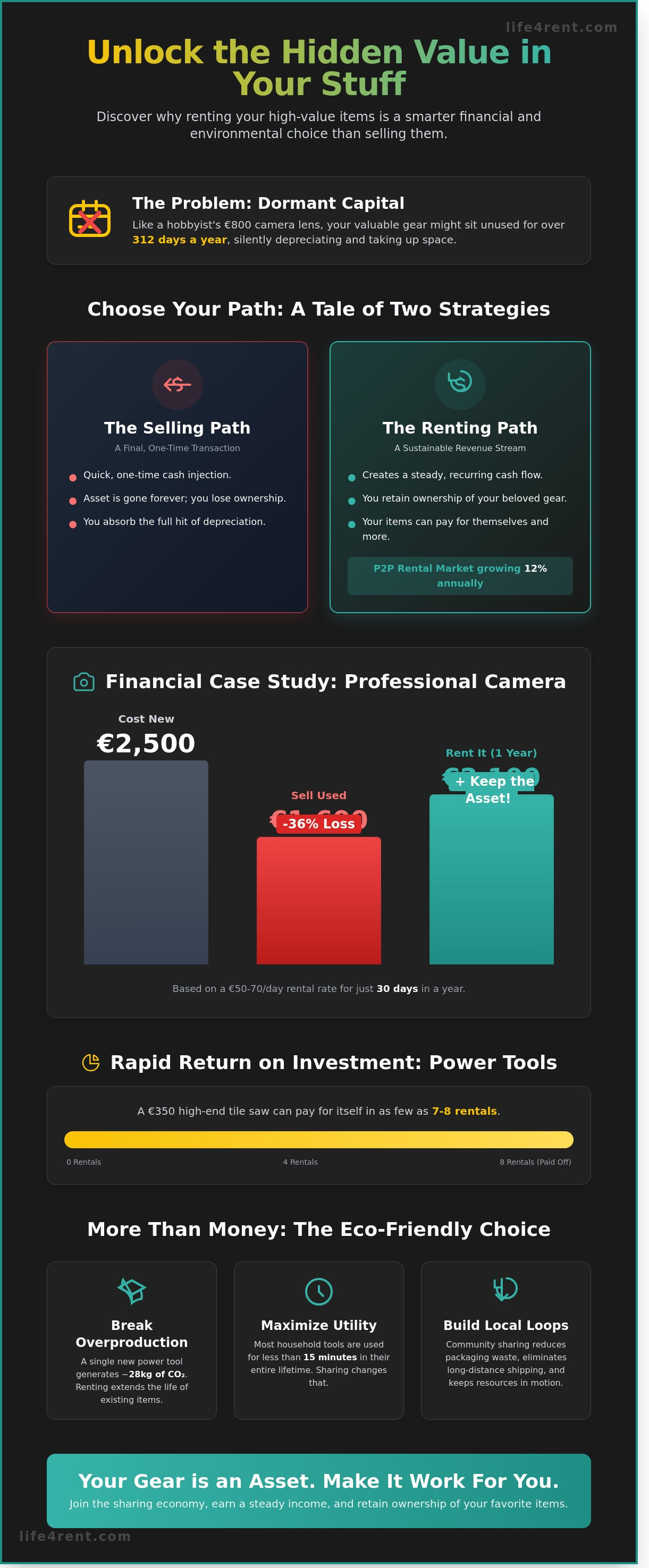
Last October, a hobbyist in Munich realized his 800-euro camera lens had sat in its protective case for 312 days out of the year. You probably have a similar high-value item taking up space in your closet right now. It's annoying to watch a significant investment lose value while it sits idle. You can make money from your stuff by letting others use it for a fair daily fee.
The peer-to-peer rental market is projected to grow by 12 percent annually through 2026. This growth creates a reliable way to generate extra cash without the stress of selling your belongings permanently. You keep the tools you love while they pay for themselves over time.
We'll cover how to price your items using current local rental data and how to use platform insurance to protect your gear. These steps ensure your side hustle stays profitable and safe from the start. You'll also learn how to vet renters to maintain the condition of your equipment.
Why you should consider renting instead of selling your belongings
A sale is a final act that leaves your shelves empty and your wallet only slightly heavier for a moment. Most people view their storage units or garages as piles of dormant capital, but these items hold more value than a simple price tag suggests. You can choose to liquidate your assets for a one-time gain, or you can choose to build a recurring revenue stream. This second path allows you to retain ownership while your gear works for you.
This model is a central pillar of the sharing economy, a system that prioritizes utility over possession. You don't have to say goodbye to your high-quality tent or your specialized automotive tools just to get a bit of liquidity. It's an effective way to make money from your stuff while ensuring you still have the right equipment for your own DIY tasks when the need arises.
To better understand this concept, watch this helpful video:
Asset depreciation is a silent thief of your net worth. A premium mountain bike might lose 30% of its value the moment you wheel it out of the shop. If you sell it after a year, you take a significant financial hit. If you list that same bike for rent on a peer-to-peer platform, you can often recoup the depreciation cost within a few months of weekend bookings.
The financial math of the sharing economy
The numbers behind peer-to-peer rentals are often more attractive than traditional investments. A professional camera like a Sony A7 IV costs roughly €2,500. On the used market, you might get €1,600 for it. Daily rental rates in European cities average €50 to €70. If you secure just 30 rental days over a year, you've earned back up to €2,100 while still owning the device.
Heavy-duty tools follow a similar logic. A high-end tile saw costs about €350 and typically pays for itself after seven or eight rentals. You also need to prepare for the 2026 tax landscape. European regulations like DAC7 mean platforms will report your earnings to tax authorities once you cross certain volume thresholds, such as €2,000 in a calendar year. It's smart to track your expenses now so you can deduct maintenance costs later.
Environmental benefits of peer-to-peer sharing
The production of a single power tool generates approximately 28kg of carbon emissions. Most household tools are used for less than 15 minutes in their entire lifetime. You help break this cycle of overproduction when you offer your equipment to others. Local rentals eliminate the need for long-distance shipping and the heavy packaging associated with new retail purchases.
Community-based sharing also helps your neighbors reduce clutter without sending functional items to the landfill. Your neighbors would usually rather pay a small fee to use a high-quality item for a day than buy a cheap, disposable version from a big-box store. This creates a local loop that keeps resources in motion. It's a logical step for anyone who wants to balance financial gain with a smaller ecological footprint and still make money from your stuff.
Which categories of items earn the most money in 2026?
Success in the rental market depends on identifying assets that people need occasionally but don't want to store or maintain. High-value items that sit idle for 90% of the year represent the best opportunity to make money from your stuff. Owners who list professional-grade equipment often see a faster return on investment compared to those offering low-cost consumer goods that are easily replaced.
High-demand tools for home improvement
Specialty machinery leads the charts for consistent earnings. Stump grinders and concrete mixers are prime examples of tools that a homeowner might use once every five years. In growing urban hubs like Tallinn or Chicago, construction and landscaping projects have increased by 12% since 2024. This creates a steady stream of DIY enthusiasts looking for professional power tools without the $2,000 price tag of a new unit.
The economic benefits of peer-to-peer rentals are most visible in these high-utility categories. You provide value by lowering the barrier to entry for complex home projects. A mid-sized concrete mixer can rent for $40 to $60 per day. If you own a garden shredder or a heavy-duty tiller, you'll find that weekend demand often exceeds local supply in residential neighborhoods.
Electronics and hobby gear
High-end electronics represent a lucrative niche for short-term needs. Mirrorless cameras like the Sony A7 series or 4K laser projectors are popular for weddings and corporate presentations. Event organizers frequently search for local sound systems and lighting setups to avoid the high delivery fees of commercial rental houses. A basic PA system with two speakers can bring in $100 for a Saturday night booking.
Virtual reality headsets and gaming consoles are popular for weekend parties or "try before you buy" scenarios. If you have a VR setup gathering dust, it could be earning $30 per day. Seasonal items require a different pricing strategy. Ski gear and paddleboards should have higher rates during peak months but lower prices in the off-season to maintain visibility. You can check current market rates on Life4Rent to see how your gear compares to others in your area.
Baby and toddler gear serves a specific, recurring market. Families visiting from abroad often need a high-quality stroller, a travel crib, or a car seat for just 7 to 10 days. These items are bulky to transport on planes, so parents prefer to rent them locally. A premium double stroller can earn $15 per day, which adds up quickly during the summer travel season. Reliability is key here; parents will pay more for gear that is clean and safety-certified.
Outdoor and sports equipment rounds out the top earners for 2026. Premium four-season tents or e-bikes are in high demand during the spring and summer. An e-bike with a replacement value of $3,500 can realistically rent for $50 per day. This is a practical way to make money from your stuff while helping others enjoy the outdoors without a massive upfront investment. Most successful lenders focus on gear that is well-maintained and includes all necessary accessories, like chargers or safety helmets.
How to handle safety and potential damage to your belongings
You need to protect your assets if you want to make money from your stuff without losing sleep. Platforms like Life4Rent provide a layer of security that private deals simply cannot match. They handle the heavy lifting of identity verification and payment processing, which reduces the risk of fraud significantly. You'll find that having a neutral third party manage the transaction details makes the entire process more professional and less stressful.
Trust relies on transparency and verified history. You should always check a renter's profile and previous reviews before you agree to any booking. Data from the 2015 safety and regulatory challenges workshop hosted by the FTC highlights how peer-to-peer markets rely on these reputation systems to protect participants. If a profile is brand new or has negative feedback from other owners, you have every right to decline the request.
Security deposits act as your first line of defense against minor mishaps. A standard deposit might range from $500 to $2,000 depending on the value of the vehicle or equipment being rented. This money stays in escrow during the rental period. It gives the renter a financial incentive to return your property in the same condition they received it, ensuring they treat your gear with respect.
Owners must learn to distinguish between normal wear and tear and actual damage. Minor scuffs on a floor mat or a few extra miles on the odometer are expected parts of doing business in a rental market. However, a cracked windshield or a stained interior requires a formal claim. Check the listing’s deposit and return conditions.
Setting clear boundaries and rules
A usage guide is a simple one-page document that tells the renter exactly how to operate and care for your specific item. You should take at least ten high-resolution photos of the item from every angle right before the renter arrives to document its current state. These images serve as undeniable proof if you need to file a claim later. You'll find that clear, written communication through the platform chat prevents 90% of potential disputes before they even start. It is your responsibility to be direct about what is and isn't allowed.
Understanding item protection plans
Standard home or auto insurance policies often don't cover items when they are used for commercial purposes. Platform-mediated protection plans fill this gap by offering specific coverage for the duration of the rental. You should review the terms to see what the deductible is before you list your items to make money from your stuff. Life4Rent uses a secure agreement framework that clearly defines the responsibilities of both parties. If a renter returns an item late, the system automatically calculates the additional fees based on the pre-agreed hourly rate. This structure ensures you are compensated for your time and any loss of use without having to argue with the customer. Professional frameworks like this turn a hobby into a reliable income stream.
Steps to set up a successful rental listing
You can turn idle equipment into a steady stream of revenue with the right approach. A high-quality listing acts as your 24/7 salesperson. If you want to make money from your stuff, you must treat your profile like a professional storefront. Most successful lenders on Life4Rent follow a repeatable pattern to ensure their items stay booked throughout the month.
Visuals provide the first impression for any potential renter. You should use a camera or a modern smartphone to capture at least eight high-resolution images. Natural light is your best tool here; position your item near a window during mid-morning. Show the front, back, sides, and any specific ports or controls. Clear photos reduce the number of questions you'll have to answer later.
Honesty in your description prevents disputes and bad reviews. You should list every technical capability but also mention the quirks. If a lens cap is slightly loose or a tripod leg sticks, say so. You'll find that the most consistent way to make money from your stuff is to build a reputation for reliability. Your response time is the final piece of the puzzle. Owners who respond to messages within two hours see a 35% higher conversion rate than those who wait until the next day.
Pricing your items for maximum occupancy
Market research is essential before you set a daily rate. You should look at five similar listings in your city to find the average price point. Many owners find success by offering a 15% discount for weekly rentals and a 30% discount for monthly bookings. This strategy ensures your gear isn't sitting on a shelf during the work week.
Prices should fluctuate based on local demand and seasons. You might charge 20% more for a heavy-duty heater in December than you would in May. When you're just starting, set your price 10% lower than the market average. This encourages the first few rentals. Once you have three positive reviews, you can move your rates back to standard levels.
The art of the item description
Technical specifications matter to professionals who know exactly what they need. You should include details like battery life, weight, and compatible software versions. A filmmaker needs to know if a camera records in 10-bit color or if a drone has obstacle avoidance sensors. Use bullet points to make these facts easy to scan.
Mention every accessory that comes in the package. You'll attract more interest if you include extras like an extra battery, a protective carrying case, or a 128GB memory card. These small additions add value without costing you extra money. Be clear about what isn't included as well. If a renter expects a specific cable and it's missing, you'll likely receive a three-star rating.
Ready to put your gear to work? You can list your items on Life4Rent today and start earning.
How Life4Rent simplifies the peer-to-peer rental process
Life4Rent organizes the marketplace into 17 specific categories to help users navigate effectively. These categories cover everything from professional power tools and electronics to specialized camping gear and party supplies. You can list a high-end camera or a simple extension ladder without worrying about where it fits in the catalog. The platform supports users in various urban centers, including Tallinn and Chicago. Localized search filters ensure that your items appear primarily to people in your immediate vicinity. This geographical focus reduces travel time for both owners and renters. It also makes the logistics of handing over equipment much simpler for everyone involved.
Trust is the foundation of any peer-to-peer system. Life4Rent implements a secure payment gateway to protect your financial interests throughout every transaction. The system collects the rental fee from the renter upfront and releases it to you once the rental concludes. You won't have to chase people for payments or deal with awkward cash handovers on the street. Reliable payment schedules make it easier to make money from your stuff consistently. Stronger local communities grow when neighbors share resources instead of buying new ones. You get to meet people in your area who share your interests while keeping high-quality items in use. This model reduces waste and helps people save money on expensive equipment they only need once.
Managing your rental dashboard
Your dashboard provides a clear overview of your rental history and future schedule. You can track exactly how much you've earned over the last 30 days with detailed reports. Transfers to your bank account are straightforward and usually process within three business days after you request a withdrawal. The dashboard also lets you switch roles if you need to borrow something yourself. You can find a heavy-duty drill for a home repair project or a roof box for a road trip without leaving the site. Credits earned from your own listings can often cover these rental costs, making the system highly efficient for active users.
Getting started today
A new listing takes less than ten minutes to complete from start to finish. You just need a few clear photos and a brief description of the item's current condition. The sharing economy is expanding, with projections from the Brookings Institution suggesting the global market will reach $335 billion by 2025. This growth means more people are looking for ways to make money from your stuff through reliable platforms. You should check the current listings in your zip code to see what others are offering. This research helps you set competitive prices based on what your neighbors are already charging. Most active users see their first booking request within the first seven days of listing an item.
- Step 1: Take three high-quality photos of your item from different angles.
- Step 2: Write a title that includes the brand and specific model name.
- Step 3: Set a daily price that is roughly 5-10% of the item's retail value.
- Step 4: Select your availability on the integrated calendar.
The platform handles the rest of the process, including insurance options and identity verification for new renters. You maintain full control over who rents your items and when they are available. This transparency ensures that your personal property remains protected while it generates passive income. Browsing the current marketplace today will show you exactly which items are in high demand in your specific city.
Turn your storage into a steady revenue stream
You can keep your belongings and still generate a monthly profit by choosing rentals over a one-time sale. Most users find that high-demand items like professional power tools or specialized camera gear pay for themselves after just four or five bookings. It's a practical way to make money from your stuff without losing ownership of the things you still occasionally use. This approach builds a recurring income stream that lasts much longer than a single marketplace transaction.
Safety remains a top priority for many owners in the peer-to-peer market. Life4Rent uses a secure payment and agreement system to protect both parties during every transaction. They currently support 17 diverse rental categories, with active communities already established in cities like Tallinn and Chicago. These verified frameworks help reduce the risks associated with lending gear to neighbors or strangers.
You don't need a massive inventory to see results. A single well-photographed listing can often start earning within a week if the price is competitive. List your first item on Life4Rent and start earning today to see how the platform works for you. You'll find that extra cash is much better than letting quality gear collect dust in your garage or attic.
Frequently Asked Questions
Is it safe to rent out my expensive tools to strangers?
Security relies on a two-step verification process for every user on the platform. You can check a person's previous rental history and ratings before you agree to the hand-over. Most owners also require a security deposit that covers 20% to 50% of the tool's retail value. This system ensures that 99% of transactions in the European market conclude without any disputes.
How much money can I realistically make from my stuff?
You can usually expect to earn between 5% and 15% of the item's market value for a single day's rental. Owners who list high-demand gear like professional cameras often earn €150 to €300 per month. If you want to make money from your stuff, focus on items worth more than €100 to ensure the effort of the hand-over is worth the fee.
What happens if a renter breaks my item?
The security deposit held by the platform covers the cost of minor damages or cleaning fees. You must report any issues within 24 hours of the return to start a claim. For more significant damage, the Life4Rent protection plan covers repairs up to €2,000 for verified listings. This process typically takes 7 to 14 business days to resolve.
Do I need special insurance to rent out my electronics?
Your standard home insurance policy likely excludes coverage for items used in a rental business. Life4Rent provides a basic protection layer for all active listings on the site. You should still verify your personal policy details, as 85% of consumer insurance contracts in the EU don't cover peer-to-peer lending.
How do I decide on a fair rental price?
Successful owners usually set their daily rate at roughly 1% to 2% of the item's original purchase price. You should look at three similar listings in your local area to ensure your price is competitive. Many users offer a 15% discount for weekly bookings to encourage longer rental periods. This strategy helps maintain a high occupancy rate for your gear.
What items are currently in the highest demand for rentals?
Power tools like hammer drills and pressure washers see the highest volume of requests throughout the year. Data from 2023 shows a 40% spike in demand for camping equipment and roof boxes during the summer holiday season. Professional photography gear also remains a top earner in urban centers. You can make money from your stuff by listing these seasonal items a few weeks before the peak period begins.
How does Life4Rent handle payments and fees?
The platform uses a secure payment gateway to process all transactions before the rental starts. Life4Rent deducts a flat 15% service fee from the total rental price to cover insurance and administrative costs. You'll receive your funds in your linked bank account within 3 to 5 business days after the item is returned. This automated system prevents payment delays or the need for cash handling.
Can I rent out my items in different cities?
You can list your gear in any location where you can facilitate the physical exchange. Some owners manage items in both their home city and a secondary location; for example, a vacation property or an office. Statistics show that 12% of active lenders on the platform operate across multiple postal codes. Just ensure your availability calendar accurately reflects where the item is located at any given time.
Life4Rent
Rent it. Earn from it. Own less, access more.
Browse peer-to-peer rentals near you, or list what you own and start earning — all protected by Life4Rent Protect.
About the author
Stockholm, Sweden
Stella researches and writes about sustainable consumption and the circular economy for the Life4Rent Renting Academy. She previously worked at a Nordic sustainability research institute studying how access-over-ownership models reduce household CO₂ emissions, and translates that research into practical guides for everyday renters.