
Apps that Help with Rent: Managing Payments and Offsetting Costs
March 25, 2026
Published by Life4Rent · Operated by Brohf Software OÜ
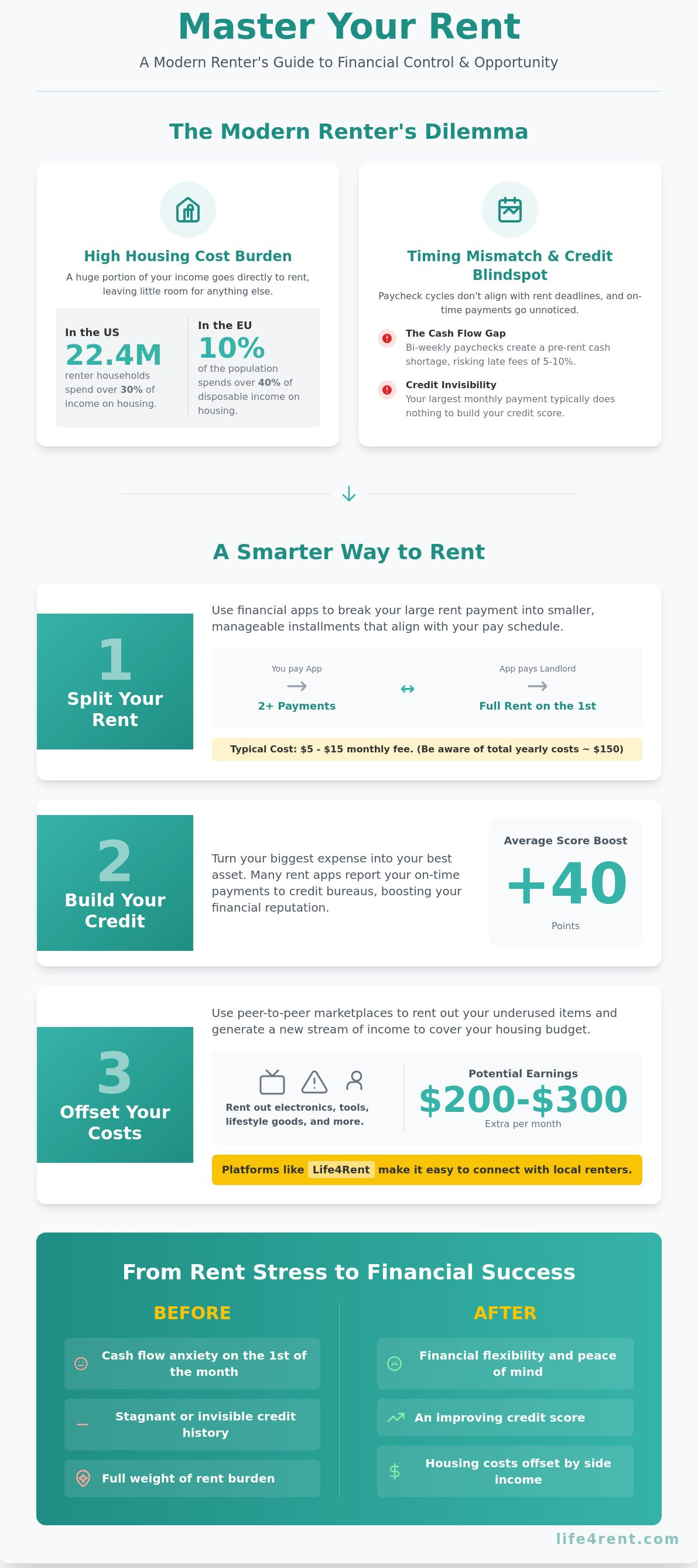
A 2023 report from the Joint Center for Housing Studies at Harvard University shows that 22.4 million American renter households spend more than 30% of their income on housing. You likely feel this pressure every month when the first of the month rolls around and your bank account looks thin. It's difficult to find reliable apps that help with rent without falling into debt traps or high-interest cycles.
Most people agree that the gap between a paycheck and the landlord's deadline is the most stressful part of the month. You want a way to manage these payments without the constant anxiety of a late fee or a hit to your reputation. This guide identifies specific financial tools that bridge those cash flow gaps and lists marketplaces where you can list items to earn the extra 200 or 300 dollars you need.
You'll see how to report your on-time payments to credit bureaus to boost your score by an average of 40 points according to data from services like Boom. We also look at how European rental platforms allow you to turn underused assets into a steady stream of income to cover your monthly overhead.
Common Challenges with Monthly Rent Payments
Rent often consumes a massive portion of the average household budget. In 2022, Eurostat reported that nearly 10% of the EU population lived in households where housing costs represented more than 40% of their disposable income. This financial weight leaves very little room for error when other bills arrive. It's a common struggle to balance these high costs while trying to maintain a decent standard of living.
Many tenants now turn to the sharing economy to find flexible ways to manage their overhead. You might find that using apps that help with rent provides a practical way to handle these large monthly transfers without draining your account on day one. These tools offer a bridge for those who need more control over their cash flow.
To better understand how these financial tools function in the real world, watch this helpful video:
The Problem with Cash Flow Timing
Most employers follow a bi-weekly or mid-month pay cycle, but landlords almost always demand the full rent on the first. This mismatch creates a period where you're "cash poor" despite having a steady job. A sudden emergency, like a broken appliance or a medical bill, can easily disrupt your ability to pay the full amount on time. Savings accounts aren't always helpful here; they often lack the immediate liquidity needed for a same-day transfer. Late fees then add to the burden, sometimes costing an extra 5% to 10% of the total rent, which makes the next month even harder to manage.
Credit Visibility for Renters
Your rent is likely your biggest expense, yet it usually does nothing for your credit history. Landlords in most European cities don't report your consistent payments to credit bureaus. You can pay on time for five years and see no improvement in your score. However, a single missed payment can be reported and stay on your record for years. Modern apps that help with rent are changing this by acting as a middleman that tracks and reports your reliability. This helps you build a financial reputation that can lead to better interest rates on future car loans or mortgages.
Financial Apps Designed to Split and Schedule Rent
Modern rental markets often require upfront liquidity that doesn't always align with bi-weekly paychecks. These digital intermediaries act as a buffer between your bank account and your landlord's ledger. Platforms like Flex or Rent.app provide a structured way to manage monthly costs without relying on high-interest credit cards. They ensure the property manager receives the full payment on the first day of the month, which helps avoid the challenges renters face when cash flow is tight.
You won't have to worry about the landlord's specific payment portal since the app handles the transfer. These platforms connect directly to your checking account via secure protocols. Once the connection is live, the app schedules the full payment to reach the landlord by their deadline. This reliability builds trust with property owners while giving you more flexibility with your liquid assets.
Most of these apps that help with rent avoid traditional interest rates. Instead, they charge a flat monthly membership fee, often ranging from $5 to $15 depending on the provider. This predictable cost makes it easier to budget than fluctuating credit card interest. You get the peace of mind that your housing is secure while you manage your other expenses throughout the month.
How Payment Splitting Works
A rent-splitting app functions as a short-term cash flow stabilizer for your monthly budget. The service pays the total rent amount to your landlord on the first of the month. You then repay the app in two or more smaller installments throughout the month. This setup mimics the rhythm of your income, especially if you get paid every two weeks. It's a practical way to keep your housing costs aligned with your actual earnings without the stress of a single large withdrawal.
Credit Reporting Features
Many apps that help with rent now include automated credit reporting. They sync with your bank account to verify every on-time payment you make. This data then goes to major credit bureaus like Experian or TransUnion. This feature is a significant benefit for people with thin credit files who want to build a history. Since rent is usually a person's largest monthly expense, reporting it can help improve a credit score over a period of 12 to 24 months.
Automated verification removes the need for manual receipts or landlord signatures. The system identifies the rent transaction in your bank feed and logs it. Over time, this consistent data provides a clearer picture of your financial reliability to lenders. If you're looking for more ways to optimize your lifestyle through shared resources, you might find a flexible rental marketplace useful for other high-value items.
Evaluating the Costs and Risks of Rent Apps
Financial tools come with strings attached. While apps that help with rent provide immediate relief, the annual costs often surprise users. Subscription fees for popular platforms like Bilt or Flex can exceed $150 per year if you opt for premium tiers. Credit card transactions usually carry a 2.5% processing fee. This means a $2,000 rent payment costs an extra $50 every single month just for the convenience of using a card.
Security is another factor to weigh carefully. Most services require your bank login credentials to verify income or automate payments. You should verify that a provider uses Plaid or a similar encrypted gateway. Data breaches remain a risk in the digital finance space. If an app fails to protect your data, your entire financial history could be exposed to bad actors.
Failure to repay these short-term loans leads to swift consequences. Most platforms suspend your account immediately after one missed payment. They often hand over delinquent accounts to third-party collection agencies within 60 to 90 days. This can damage your credit score significantly, making it harder to secure a lease in the future. You are essentially trading long-term credit health for short-term liquidity.
A Checklist for Choosing an App
Verify that the service works with your specific landlord's payment portal before you sign up. Many apps that help with rent only support large property management systems like Yardi or Entrata. Compare the monthly subscription fee against your landlord's late fee. If the app costs $15 but your late fee is $50, the math works in your favor. Always look for FDIC-insured partners to ensure your funds are protected during the transfer process.
The Reality of Debt Cycles
These platforms function best as cash-flow management tools. They don't solve the problem of a low income or high cost of living. You shouldn't rely on credit to cover basic housing costs every month. This habit often masks deeper financial instability. Transparency is your best defense here. Read the fine print to find hidden "expedited payment" fees that can quietly drain your bank account over time.
Offsetting Rent Costs Through Peer-to-Peer Marketplaces
Marketplaces provide a practical way to generate income from assets that usually sit idle in a closet or garage. You can turn these underused items into steady cash flow to help manage monthly housing expenses. While many people think of side hustles as extra jobs, these platforms focus on asset utilization instead of labor. It's a method that values what you already own.
Data from 2023 shows that the European sharing economy grew by 15% as more people chose access over the heavy cost of ownership. This shift creates a reliable stream of users looking for temporary solutions. These apps that help with rent provide a way to monetize your existing inventory without much overhead. Neighbors save money by not buying new products, and you recoup a portion of your living costs. It's a cycle that benefits the local community while keeping your budget intact.
High-Demand Items for Rental
Power tools and DIY equipment often sit unused for 95% of their lifespan. A heavy-duty hammer drill might cost €150 to buy but can rent for €15 to €20 per day. Professional electronics like 4K projectors or mirrorless cameras often command rates between €40 and €80 daily. Families traveling with infants represent another strong market. They often pay €10 per day for a high-quality travel crib to avoid airport luggage fees. You'll find that specialized apps that help with rent often highlight these categories because they move quickly.
Safety and Insurance in P2P Rentals
Trust is the foundation of any peer-to-peer transaction. Most reputable platforms require users to complete a multi-step verification process. This usually involves ID checks and linked social profiles to ensure accountability. Protection plans are standard now; they typically cover the replacement value of an item if it gets damaged or lost during a rental period. You don't have to worry about the financial risk of a stranger using your gear.
Direct communication helps clarify expectations before an exchange happens. You can ask about the intended use or provide specific handling instructions. This transparency reduces the risk of disputes and builds a local network of reliable users. Check out the Life4Rent marketplace options to see how you can start listing your own equipment and generating extra income today.
Using Life4Rent to Supplement Your Housing Budget
Life4Rent operates as a peer-to-peer marketplace where you can list tools, electronics, or camping gear for others to borrow. You won't find a simpler way to turn idle household objects into a steady stream of extra cash. The mobile interface allows you to upload an item's details and photos in about three minutes. Because the platform manages all financial transactions, you don't have to worry about chasing down payments or handling cash in person. People looking for apps that help with rent often overlook the value sitting in their own storage units or closets.
The system holds the renter's payment in escrow until the transaction is complete. This protection reduces the risk for both parties and builds trust in the community. You can track your earnings directly in the dashboard to see how close you are to your monthly targets. Frequent borrowers also benefit because they avoid the high cost of purchasing items they might only use once a year. This shared approach keeps more money in everyone's pockets while reducing local waste.
Starting Your First Listing
Your success on the platform depends on how you present your items to potential renters. Take three or four high-resolution photos in natural light to show the actual condition of your gear. You should research similar listings to set a daily price that attracts attention while remaining profitable for you. Fast communication is a major factor in the ranking algorithm. Most successful owners respond to messages within 60 minutes to keep their user ratings high and secure more bookings.
Reaching Your Financial Goals
Small amounts of extra income add up when you're looking for apps that help with rent to balance your monthly budget. If your monthly rent is €900, you only need to earn €90 from rentals to cover 10% of your housing cost. You can reach this goal by renting out a professional-grade power tool or a mid-range projector for just three or four days a month. Keep your equipment clean and check for wear after every transaction to ensure it stays in good working order for the next user.
- Check out Life4Rent to see what items are currently in high demand in your specific neighborhood.
- Compare your prices to local rental shops to stay competitive.
- Update your availability calendar regularly to avoid canceling requests.
This data helps you decide which of your possessions are most likely to generate consistent returns throughout the year. You'll find that seasonal items like roof racks or pressure washers often command higher prices during peak months. Consistency is the key to turning a side project into a reliable part of your financial planning. By focusing on maintenance and quick communication, you can build a profile that supports your lifestyle without requiring a second job.
Turn Your Storage Into Rent Money
Monthly expenses often require more than just a simple budgeting tool. Many apps that help with rent focus on splitting bills or building credit, but they don't always address the gap between your income and the actual cost of living. You can bridge this gap by looking at the items you already own but rarely use. This approach turns idle assets into a secondary income stream.
Life4Rent offers a practical way to earn extra cash through 17 different item categories ranging from tools to electronics. This platform handles secure payment processing for all rentals, which reduces the risk of payment disputes between neighbors. The community started in Estonia and now connects people across borders who want to share resources instead of buying new ones. It's a reliable system for those who want to see real results from their inventory.
You can list a camera, a power tool, or even a camping set to start seeing a return on your past purchases. It's a straightforward way to make your housing costs feel more manageable each month. Many people find that renting out a few items can cover the cost of an internet bill. Start listing your items on Life4Rent to help cover your monthly costs and see how much your gear can earn. You'll likely find that your neighbors are looking for exactly what you have stored in your closet.
Frequently Asked Questions
Do apps that help with rent charge interest?
Most apps that help with rent don't charge traditional interest rates, but they do apply fixed service fees. You'll typically pay between $1 and $15 per month for a subscription or a flat $5 fee for instant transfers. These costs can add up if you use the service every month. It's better to treat these as short-term bridge loans rather than a permanent financial strategy for your housing costs.
Can I use a rent app if my landlord only accepts checks?
You can still use these platforms even if your landlord demands a physical check. Services like Circa or Flex pay the full amount to the property manager via mail or electronic transfer, then you pay the app back in smaller chunks. This process usually takes 3 to 5 business days to clear. Always check your lease to ensure your landlord accepts third-party payments before you sign up for a service.
Will using a rent-splitting app hurt my credit score?
Your credit score won't drop just because you use a rent-splitting app. In fact, 90% of these services only report on-time payments to bureaus like Experian to help you build a better history. Problems only arise if you miss a repayment to the app itself. If the app has to send your debt to a collection agency, your score could fall by 50 points or more quite quickly.
How much can I realistically earn by renting out my tools?
You can expect to earn between €15 and €40 per day for high-demand items like power washers or industrial drills. Most users on peer-to-peer marketplaces report an average monthly income of €150 if they list at least five quality tools. Keep in mind that platforms usually take a 15% to 25% commission on every transaction. Maintenance and cleaning are your responsibility, so factor those costs into your daily pricing.
Are there apps that help with rent deposits for new apartments?
Several apps that help with rent also offer deposit alternatives to lower your move-in costs. Companies like Rhino or Obligo allow you to pay a small monthly insurance fee, often between $5 and $15, instead of a massive upfront cash deposit. This keeps more money in your pocket today. However, you're still liable for any damages to the apartment when you move out at the end of your lease period.
Is it safe to link my bank account to these platforms?
It's generally safe to link your account because most reputable apps use Plaid, a secure middleman that connects over 12,000 financial institutions. These platforms never see your actual login credentials. You should still enable two-factor authentication on every app you use for extra security. Data breaches are rare, but they can happen, so monitor your bank statements for any unauthorized transactions at least once a week.
What happens if I cannot repay the rent app on time?
You'll likely face late fees ranging from $25 to $35 if you miss a scheduled repayment. Most apps will also suspend your account, meaning you won't be able to borrow for next month's rent. If the debt remains unpaid for 60 days, the company might sell your account to a collection agency. This will negatively impact your credit report and make it much harder to rent an apartment in the future.
Do I need to pay taxes on money earned from rental marketplaces?
You must report your earnings if they exceed specific local thresholds. In the European Union, the DAC7 directive requires platforms to report any user who earns over €2,000 or completes more than 30 transactions in a calendar year. You'll need to include this as miscellaneous income on your tax return. Keep your receipts for maintenance and platform fees, as these are often tax-deductible expenses that can lower your bill.
Life4Rent
Rent it. Earn from it. Own less, access more.
Browse peer-to-peer rentals near you, or list what you own and start earning — all protected by Life4Rent Protect.
About the author
Tallinn, Estonia
Philip leads editorial at the Life4Rent Renting Academy, overseeing guides on peer-to-peer rental, platform safety, and consumer finance across 25 markets. He has spent over a decade covering the sharing economy and digital marketplaces, helping renters and owners navigate the shift from ownership to access.