
2026 Construction Air Scrubber Rental Guide
October 12, 2026
Published by Life4Rent · Operated by Brohf Software OÜ
What if the air scrubber that looks right on a rental listing isn’t suited to the dust or room on your site? Comparing equipment by name alone can leave out the details that matter: filtration, airflow, room conditions, and how the work will run. For air scrubber rental for construction, let the project guide the choice.
Choose a unit that suits the dust your work creates, fits the space, and covers the right part of the schedule. A filter label alone doesn’t tell the whole story, and reserving for too little or too long can complicate a job already running to a tight plan.
This guide covers the jobsite conditions and air-cleaning needs to consider, how to compare rental listings, and how to plan setup, operation, and return around your construction timeline. On Life4Rent, short-term access to tools and equipment can make sense when a project needs a machine temporarily rather than permanently. Clear project details make it easier to assess whether a listing fits.
What an Air Scrubber Does on a Construction Site, and When Renting Makes Sense
An air scrubber is a portable unit that draws air through its specified filters and sends filtered air back into the work area or, if the setup allows, through ducting. On a construction site, it can help manage airborne particles from tasks such as sanding, cutting, or demolition. For those developing hands-on building and woodwork skills through intensive trade courses like ytatraining.com, understanding how to manage airborne hazards is a core part of safe site practice. An air scrubber filters airborne particles from the air it processes, but it doesn’t remove every hazard or replace other dust controls.
For a general overview of air-cleaning devices and filter types, see What is an Air Purifier? Construction units are selected for job conditions, so check the stated filtration and airflow. Performance also depends on filter condition, setup, and the work area.
How an air scrubber fits into dust control
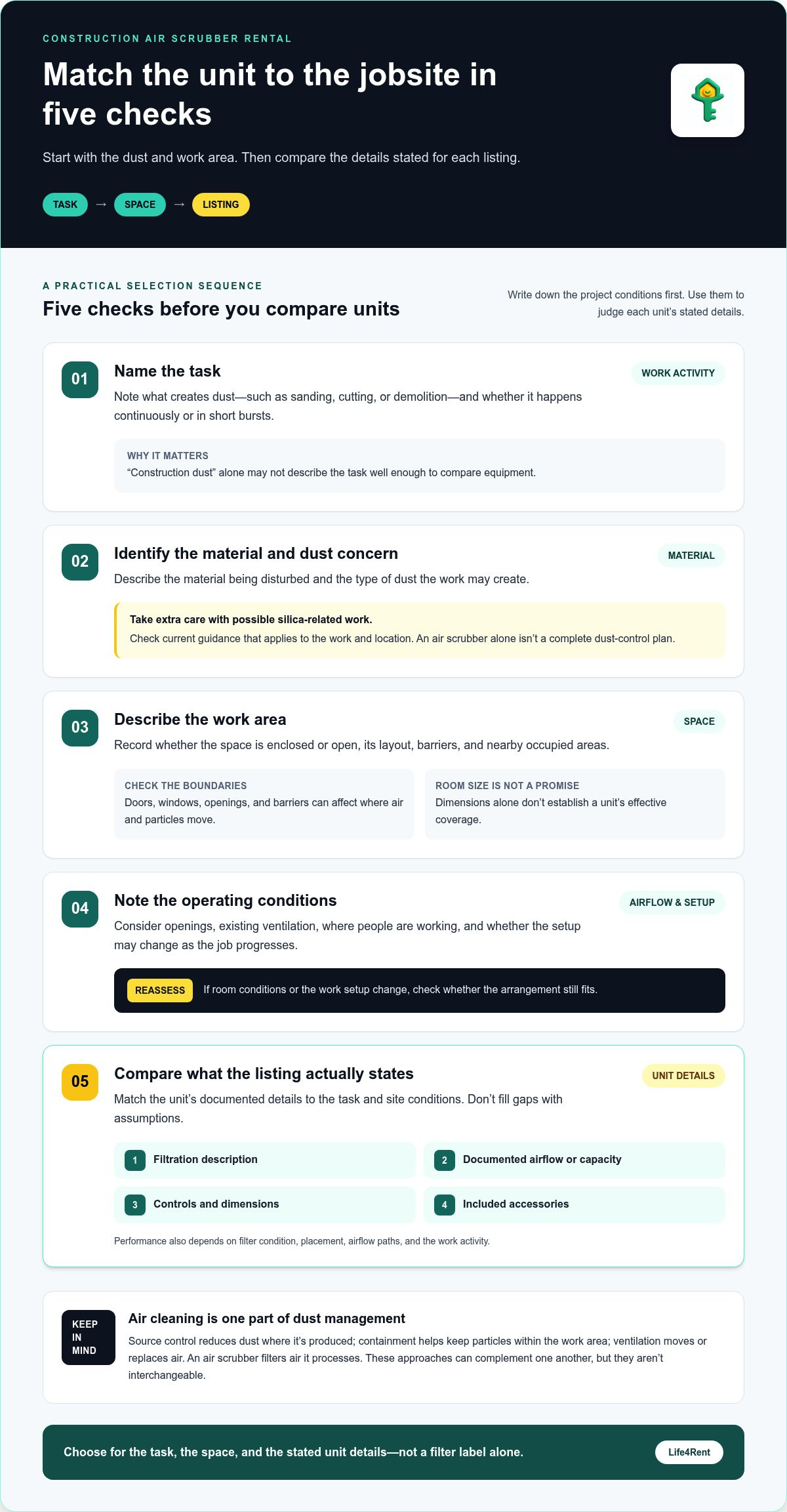
Air cleaning is one part of dust management, not the whole plan. Source control aims to reduce dust where it’s produced, while containment helps keep particles within the work area. Ordinary ventilation moves or replaces air; an air scrubber passes air through the unit’s filters. These methods can complement one another, but they aren’t interchangeable.
A renovation task that creates dust may need controls at the tool and work surface, a defined work area, and air cleaning suited to the conditions. Filter stages and performance vary by unit. A filter label alone doesn’t show how the machine will perform in a particular room, so compare the listing’s stated details rather than assuming all units work alike.
Some construction tasks involve material-specific concerns. Dust from material that may contain silica, for example, calls for more than an assumption that a portable air cleaner is enough. Identify the material and task, then consider air cleaning alongside appropriate source control and site procedures.
When a temporary rental can fit the project
A short-term rental can suit a defined phase of work, such as a contained renovation in one room or a demolition stage that produces airborne dust. Once that phase ends, the equipment may no longer be needed. Professional suppliers like Pahrump Rentals & Hardware note that renting provides practical temporary access without long-term storage and upkeep, while ownership only makes sense if the unit will be used regularly across projects.
Plan the rental around the actual work window. Include setup and the time the unit is needed during dusty tasks, then allow for possible schedule changes when planning the return. This is more useful than choosing dates based only on the project’s overall start and finish.
For a broader look at temporary access versus ownership, the peer-to-peer equipment rental guide explains how renting can fit needs limited to a particular project. The same principle applies to air scrubber rental for construction: match the equipment and rental window to the work, and don’t treat the machine as a substitute for a complete dust-control plan.
Matching Air Scrubbers to Dust and Site Conditions
The right machine depends on what the work will release and where it will happen. Before comparing listings, note the task, material, space, and conditions in which the unit must operate. Project conditions determine which equipment details matter, so match the listing to the job rather than choosing by a single number or filter label.
Start with the material and work activity
Identify what workers will cut, sand, remove, or otherwise disturb. Surface sanding, masonry breaking, and removal of old finishes can create different kinds and amounts of airborne dust, so “construction dust” alone may not describe the job well enough.
- Name the task. Note the activity that creates dust and whether it happens continuously or in short bursts.
- Identify the material and dust concern. General dust and dust from material that may contain silica aren’t interchangeable concerns. Silica-related work needs careful attention to current, applicable exposure guidance and appropriate work controls.
- Describe the work area. Record whether it’s enclosed or open, its layout, any barriers, and nearby occupied spaces.
- Note operating conditions. Consider openings, existing ventilation, where people are working, and whether the setup may change as the job progresses.
- Compare the listing specifications. Use only details stated for that particular unit, such as its filtration description and documented capacity. Don’t fill gaps with assumptions.
Assess the room, airflow, and work boundaries
A small enclosed room with a clear work boundary presents different setup questions from a large, open area or a room connected to occupied spaces. Doors, windows, other openings, barriers, and ventilation can affect how air moves and where particles may travel. Reassess the setup if those conditions change during the job.
Room dimensions help describe a space, but they don’t establish a unit’s effective coverage by themselves. Treat stated capacity as a manufacturer or listing detail, not a promise that the unit will perform the same way in every layout. Filter condition, placement, airflow paths, and the work activity can all affect performance.
Silica-related concerns also call for checking current guidance that applies to the work and location. The EPA Clean Air Act Regulations page offers broad US air-quality context, but it isn’t a substitute for applicable construction or worker-exposure guidance. For projects in Europe, use relevant local guidance rather than assuming a US overview sets requirements for the site.
With these conditions written down, air scrubber rental for construction becomes a more focused comparison. Judge each listing against the task and space, then decide whether its stated details fit. If temporary access suits the project, compare equipment rental listings on Life4Rent using your job-specific checklist.
Which Air Scrubber Rental Details Matter Most when Comparing Options?
A useful listing comparison separates documented facts from assumptions. For air scrubber rental for construction, start with details that affect filtration, airflow, and whether the unit can be handled and operated in your work area. Compare specifications explicitly supplied for each unit. A missing figure isn’t evidence that two machines are equivalent.
| Listing detail | What to compare | Why it matters |
|---|---|---|
| Filtration description | Filter type or classification, and any stated filtration stages | Shows what the listing says the unit is designed to filter. “HEPA” describes a filtration category, not a guarantee that every exposure or work hazard is controlled. |
| Documented airflow | The stated figure and how it is presented | Airflow can help compare units only when figures are measured or reported on a comparable basis. Don’t treat unlike figures as equivalent. |
| Controls | Controls or operating modes described in the listing | Helps you understand what adjustments are documented without assuming the unit has unlisted settings. |
| Dimensions and weight | Listed measurements and weight | Helps assess placement, movement through access routes, and available floor space. |
| Accessories | Included items, such as any listed hose or duct connections | Clarifies what the listing says comes with the unit. Don’t assume accessories are included if they aren’t described. |
Read filtration and airflow information carefully
Read the filtration description alongside the unit’s documentation, not as a stand-alone promise. If a listing names a filter classification, use that exact information to compare it with the requirements of the task. HEPA wording alone doesn’t establish that a unit suits every dust type or exposure concern. An air scrubber also shouldn’t replace other work controls.
Airflow figures need context too. A number may describe a particular configuration or test basis, while performance in the work area can be affected by setup, filters, and conditions. Compare like with like, and don’t infer room coverage from a stated figure unless the listing or manufacturer documentation supports that interpretation.
Check handling, power, and operating requirements
Think through the route from delivery point to operating position. Listed dimensions and weight can help you judge whether the unit fits through access routes and where it can stand without obstructing work. Check the stated power requirements against what’s available at the site, and look for documented control information that suits the planned operation.
Filter replacement may affect how the unit is managed during a longer task, so follow any listed instructions rather than guessing about maintenance. Include sound levels and hose or duct connections in your comparison only when the listing documents them. A concrete mixer serves a different task from an air scrubber, which manages airborne particles; the concrete mixing equipment guide illustrates why equipment details should be judged against the job they’re meant to support.
Use the same comparison points across listings, then weigh the documented details against your site needs. Compare equipment rental listings on Life4Rent using the specifications that matter for your project.
How to Plan an Air Scrubber Rental Around the Construction Schedule
A rental plan works best when it follows the dusty part of the job, not automatically the full project. Set the work window first, then account for setup, operation, possible delays, and return. A clear plan also helps the site team agree on who handles the unit and when.
Plan timing, transport, and setup
Start with the task schedule. If dusty work is planned for a defined renovation or demolition phase, base the rental dates around that phase and allow for likely changes. Don’t assume the scrubber is needed from the first day to the last. Rental terms vary, so use the dates and arrangements stated for the particular listing.
- Define the work window. Note when dusty work is expected to begin and end, and identify likely schedule changes that could affect the rental period.
- Map the route and placement. Check how the unit will reach the work area, whether it fits through access routes, and where it can sit without blocking work or walkways.
- Plan the setup. Review the unit instructions and listed accessories. Account for available power and any ducting or hose connections described for that unit.
- Assign responsibilities. Decide who will receive the equipment, position it, operate it, carry out routine checks, and arrange its return.
These details are easy to overlook during a busy site handover. A unit that arrives during active work may be awkward to move into position, while an unclear plan for power or access can delay setup. Broader tool rental planning advice can also help you plan timing and temporary equipment needs across the project.
Set expectations for operation and return
Before use, follow the instructions for operation, cleaning, and filter handling. Establish who will carry out any routine checks specified for the unit, and how the team will manage filter needs during the planned work. Don’t assume maintenance steps or replacement materials that aren’t described in the instructions or rental details.
At collection or handover, record the unit’s condition and the accessories supplied. A written note or clear photos can help both sides keep track of what was received and make return planning more straightforward.
- Allow for shutdown and handling. Include time to stop the unit and disconnect any listed accessories according to its instructions.
- Prepare the return. Follow the stated cleaning and filter-handling instructions, then plan how and when the equipment will be handed back.
- Leave room for changes. If the dusty phase shifts, revisit the rental dates and arrangements rather than assuming the original schedule still fits.
A practical air scrubber rental for construction plan connects the work calendar to the unit’s setup and return requirements. Compare equipment rental listings on Life4Rent against your project dates and handling plan before making arrangements.
Find a Construction Air Scrubber Rental Through Life4Rent
Life4Rent is a peer-to-peer rental marketplace where people list items and others seek them for temporary use. That model can suit construction equipment needed for a project phase rather than as a permanent purchase. Compare each relevant listing with the actual work, since equipment in the same broad category may not suit the same job.
For air scrubber rental for construction, use your task and site checklist to assess the details provided for each unit. A clear comparison helps you judge whether the documented specifications, rental dates, and practical arrangements fit your plan.
Compare marketplace listings against your project checklist
Start with the filtration description and any documented airflow, then look at controls, dimensions, weight, and accessories. Keep each detail tied to the specific unit described. For example, a listing’s filter information applies to that equipment, while another unit’s stated airflow should not be treated as equivalent unless the figures are presented on a comparable basis.
- Task and dust: Note the work activity and material, including any specific dust concerns that affect your air-cleaning needs.
- Site fit: Compare unit dimensions and weight with the access route and intended placement area; consider the available power and work boundaries.
- Documented details: Review stated filtration, airflow, controls, and included accessories without filling in gaps through assumptions.
- Timing and handling: Compare rental dates with the dust-producing phase, and account for setup, routine checks, and the planned return.
Equipment needs change with the task. An excavator has a different job and selection criteria from an air scrubber, but the same principle applies: match the machine’s stated details to the work planned. The excavator rental selection guide offers another example of comparing equipment with a specific job in mind.
Make the rental decision with a clear handover plan
Before settling on a listing, bring the key pieces together: the task, the dust concern, the filtration information you need, the site layout, the operating plan, and the rental window. Check that practical arrangements fit too, including how the unit will reach its position, who will manage it during use, and how it will be returned.
Use the listing details for the particular unit and follow its equipment instructions for setup, operation, cleaning, and filter handling. At handover, note the equipment’s condition and the accessories supplied so the return plan is clear to everyone involved.
A short-term rental can suit work with a defined end point, but the right choice depends on project fit and the details of the individual listing. Explore rentals on Life4Rent and compare the available listing information with your construction plan.
Make the Next Rental Decision with Confidence
Before arranging an air scrubber rental for construction, turn your notes into a short job brief covering the task, site conditions, unit requirements, and rental dates. Use it to compare options consistently. If the scope or schedule changes, review the fit rather than relying on the original plan.
Keep the brief accessible to whoever will oversee the equipment handover. They can use it to spot changes that affect placement, operation, or return timing and adjust the plan before those changes become a last-minute problem.
With your requirements clear, explore rentals on Life4Rent and compare listing details with your project plan. A considered choice makes the rental easier to manage from setup through return.
Frequently Asked Questions
What does an air scrubber do during construction?
During dusty work, an air scrubber draws airborne particles through its filters and returns filtered air or, where the setup allows, moves air through ducting. It can help manage particles that remain airborne after dust is created, but it doesn’t prevent dust at the tool or material. For example, it may support air management during debris handling alongside controls that reduce dust at its source.
Is an air scrubber the same as an air purifier?
The terms overlap because both describe equipment that filters air, but the label alone doesn’t show whether a unit fits a construction task. A portable scrubber may be designed for worksite use, while “air purifier” can refer to a broad range of devices and settings. Compare the particular unit’s documented filters, airflow, setup instructions, and intended use rather than choosing based on the name.
How do I choose the right air scrubber for construction dust?
Start with the material and activity, then match the unit’s documented filtration and airflow information to the work area and operating plan. For air scrubber rental for construction, also consider day-to-day details, such as whether the unit fits through the access route and whether its stated power needs suit the site. Use specific listing details to compare the unit with the job.
Can an air scrubber remove silica dust from a construction site?
A scrubber may capture airborne silica particles only when its documented filtration and setup are suitable for the work. Don’t assume a general filter label means a unit controls every silica exposure. Silica-related tasks need appropriate dust controls and attention to current guidance that applies to the location and work. Treat air cleaning as one part of that plan, not as proof that exposure is controlled.
How long should I rent an air scrubber for a construction project?
Plan around the period when the unit is actually needed, plus time for setup and shutdown, rather than automatically reserving it for the full project. A renovation might have a distinct dusty phase followed by work that doesn’t need the scrubber. Check the specific listing’s rental dates and terms, and account for likely delays so the end date doesn’t arrive before the task is complete.
What should I check before arranging an air scrubber rental?
Review the listing for the unit’s filtration description, documented airflow, dimensions, power needs, controls, and included accessories. Read the rental terms and equipment instructions to understand the stated arrangements for use, filter handling, and return. Before the rental begins, make sure the site team knows who will receive the unit and where it will be placed. Record its condition and supplied items at handover.
Is renting an air scrubber better than buying one?
A rental can suit a one-off project or a short work phase, especially if you’d otherwise need to store and maintain equipment that may sit unused. Buying may make more sense when regular use across jobs justifies the space and ongoing upkeep. Compare expected frequency of use with storage, maintenance, and filter needs. The practical choice depends on how often the equipment will earn its place in your work routine.
Life4Rent
Rent it. Earn from it. Own less, access more.
Browse peer-to-peer rentals near you, or list what you own and start earning — all protected by Life4Rent Protect.
About the author
Dublin, Ireland
Michael covers consumer rights, rental law, and EU platform regulation for the Life4Rent Renting Academy. He has reported on digital market policy and renter protections across Europe, and brings a clear, practical perspective to topics like deposit disputes, insurance, and the legal rights of renters and owners.